



Pattern Counsel is written for General Counsel, Chief Legal Officers and their teams — and for the law firms, legal operations professionals and technology providers who work alongside them. This work is AI-assisted — read about how I work.
Pattern Counsel reflects my vision of how in-house legal functions could work. Many General Counsel will see it differently.
Introduction
Being inside is not the same as learning from inside.
The first instalment of Pattern Counsel argued that legal value compounds through embeddedness. Being inside the enterprise produces a different kind of knowledge, and each cycle of presence can sharpen the next judgment.
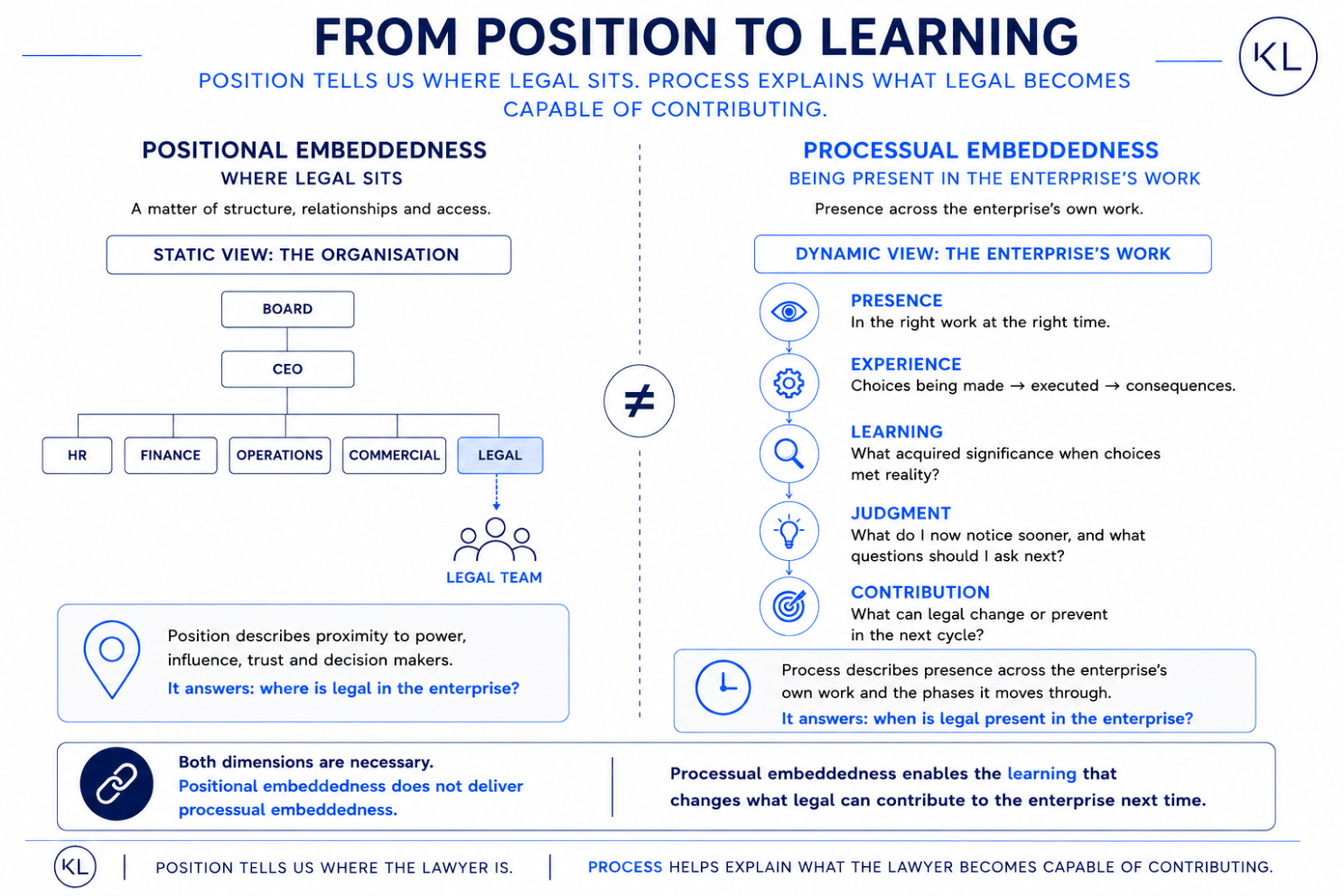
The second looked more closely at what “inside” means. Position matters: where legal sits, who it reports to, which rooms it can enter. But position does not guarantee presence across the enterprise’s work. Processual embeddedness is something different: legal being present in the phases where the enterprise’s work creates, manifests or exposes legal risk.
There is another consequence of that distinction. Processual embeddedness does not simply put legal in the work early enough to influence it. It puts the lawyer inside an experience from which she can learn — seeing choices being made, living with what happens to them and remaining present when the consequences become clear.
That changes the lawyer.
Changing the lawyer is not the purpose of embeddedness. The purpose is what the enterprise can do differently because legal is there.
What do you know?
A month before I became Head of Group Legal South Africa for a multinational mining company in 2010, I met one of the general counsel whose world I was about to enter. He had been in the system for years. I had not.
He looked at me across the table. “What do you know?”
It was a formidable question because he knew an enormous amount. Mining law. Regulatory history. The institution. The matters that had shaped it. I knew very little of that. For a while I tried to catch up.
It was miserable.
There was always another piece of legislation, another regulatory turn, another fact buried in years of correspondence or litigation. What I understood only later was that there were different ways of being inside. That veteran of Group Legal was profoundly positionally embedded. Years inside had given him knowledge I could not reproduce by reading harder.
But position is not the same thing as being embedded in the processes through which the enterprise does its work.
My mistake was thinking the answer to “What do you know?” was simply to know more law.
The more consequential opportunity was to get further inside the work.
Learning from the process
A lawyer can know almost everything about a matter without having experienced the process that produced it. An external lawyer can reconstruct a transaction from the papers. A litigator can reconstruct a dispute. A regulatory specialist can master the history of a permit. All may know more law than the lawyer inside.
Processual embeddedness offers something different.
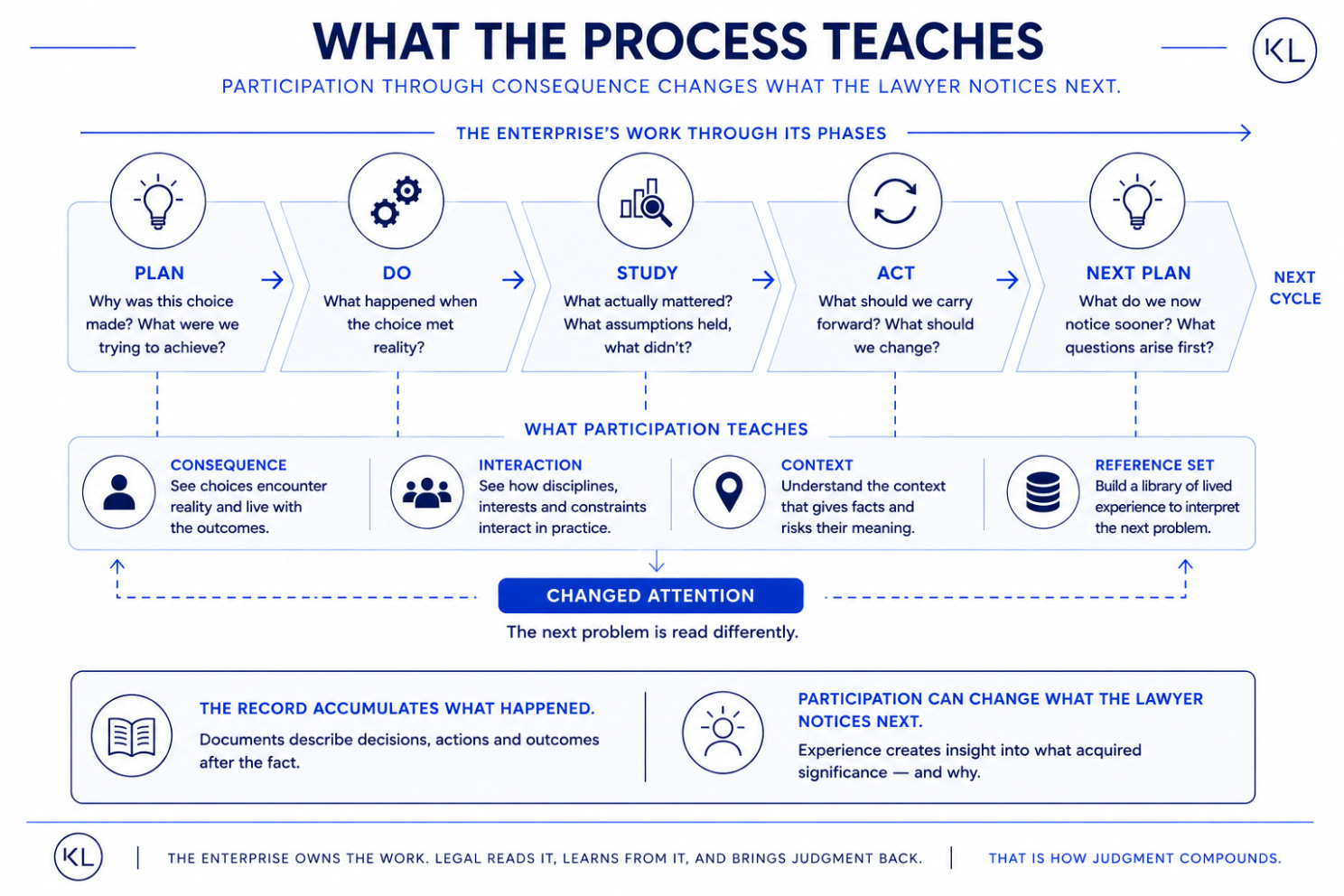
At Plan, you experience why choices are made while alternatives are still open. At Do, you watch those choices encounter operations, economics, regulators and people. At Study, you see which assumptions held and which consequences nobody predicted. At Act, you see what the enterprise decides to carry into the next cycle. Then you arrive at the next Plan.
The cycle belongs to the enterprise, not legal. Legal rarely runs it. The value lies in being sufficiently present to read it from inside: to see how different disciplines interact, where risk actually emerges and what becomes significant when a choice encounters reality.
That last part matters. The record can tell you that an option was abandoned. Participation may tell you why an apparently minor operational constraint suddenly made it impossible. The papers can record what a regulator said. Being there may teach you why one comment changed the room while another was ignored. A risk register can tell you what people thought might happen. Staying through the work tells you what actually constrained the decision.
That is more than additional information. It is learning what acquired significance. And because you were accountable alongside others for some part of the outcome, the consequence is not merely something you observe. You have to live with what the judgment did.
The first instalment called the result “diagnostic precision”: the lawyer who had lived successive permitting cycles knew which questions to ask because she had been there when the earlier answers formed. She was accountable alongside engineers, hydrologists and the community team for whether the permit landed or failed.
The record tells you what happened. Participation begins to change what you notice next.
What you begin to notice
Over time I developed a habit of looking backwards before answering forwards. What happened before this? Why are we here? Who has seen another part of it? What apparently unrelated work touches this? What happens if we pull that loose strand?
Earlier experience began doing something more useful than supplying answers.
Sometimes it supplied a question.
That is a small distinction, but I think an important one. Processual experience creates a reference set. You have seen choices become consequences. You have seen legal, operational, financial, human and regulatory considerations interact rather than arrive as separate inputs. You have learned something about what matters here, rather than what ought to matter in theory. That begins to change how the next problem looks.
It can also mislead you.
I learned that on work in Latin America. A community challenge around a water-use licence looked familiar through my South African experience. Community litigation. Organised opposition. Mining. A colleague asked a simple question that made me look again.
The mechanism I had read as opposition was, in that setting, part of an ordinary way in which a licensing decision could be challenged or reconsidered. My experience had allowed me to recognise a pattern quickly. It had also allowed me to recognise the wrong one.
That is an important limit to the embeddedness claim.
Experience does not automatically become judgment. Sometimes it makes you wrong faster.
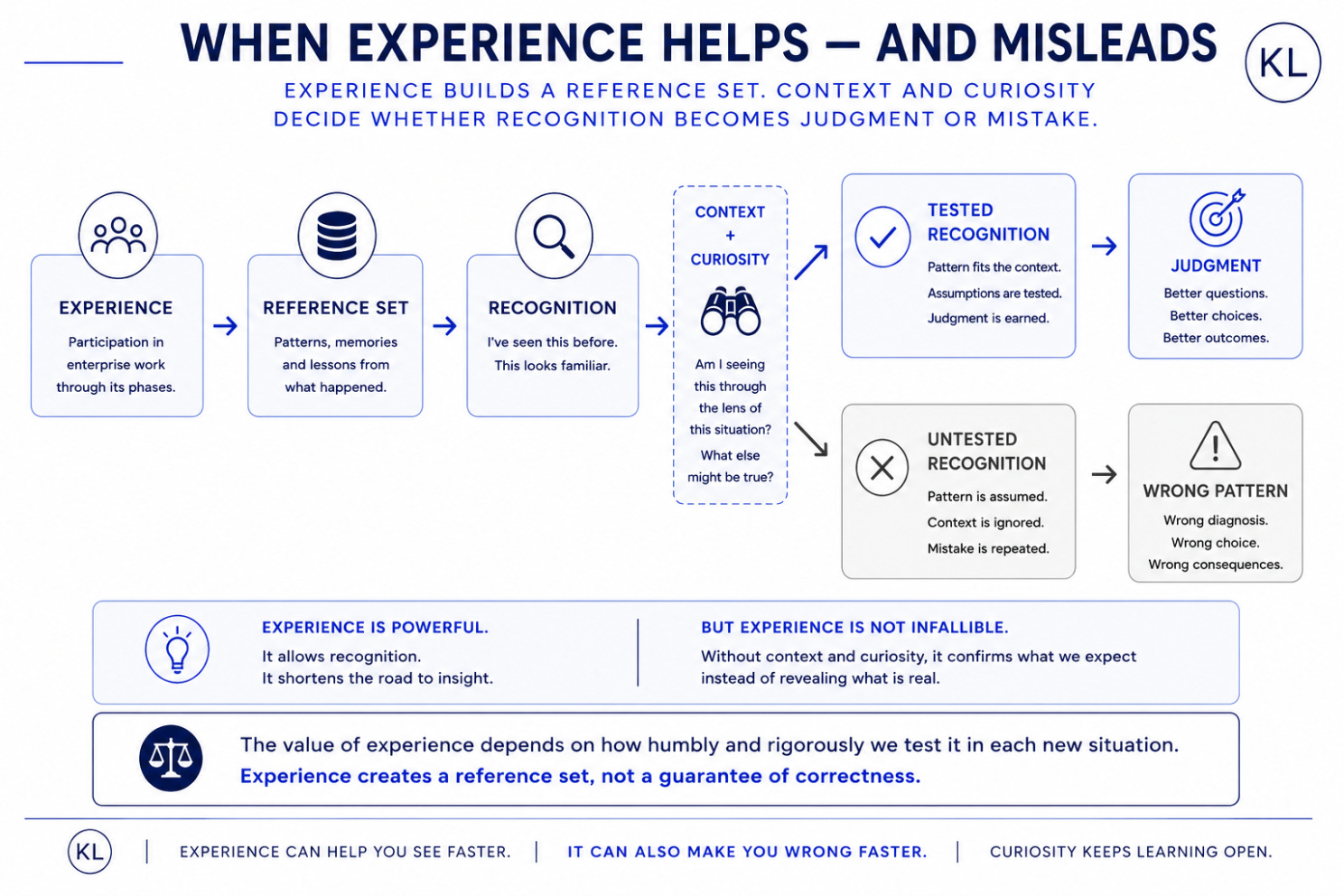
The reference set has to remain open to context.
Learning safety from pilots
I saw the more valuable possibility in a lawyer we deployed into the centre of our mine safety management system. That description matters. He remained a lawyer. He did not run the safety system. But he was accountable from within it, working alongside people whose enterprise objective was to prevent people being injured or killed.
He was no longer encountering safety principally through legislation, investigations and the consequences of incidents. And the system began teaching him.
One of the things he came to see was the strategic importance of learning itself. A serious incident at one operation contained knowledge that might prevent another somewhere else. A safety system therefore needed not merely to investigate incidents, but to allow learning from them to travel.
That created a tension with something legal was doing for perfectly defensible reasons: privilege. There are good reasons to protect investigations and related material when facts are uncertain, consequences serious and legal exposure real. But he was now looking at privilege from inside the safety system. If protection became so complete that one mine could not learn from another, what did that do to the enterprise’s ability to become safer?
The law had not changed. The lawyer had. And that changed the question.
It was no longer simply: what should we protect? It became: how do we preserve the protection genuinely needed while allowing enough learning to travel to help prevent the next injury or fatality?
Then he made another connection. Mining cannot be the only activity in which people make difficult decisions inside complex systems where mistakes can kill. What might mine managers learn from airline pilots? What might both learn from heart surgeons? What had those disciplines discovered about near misses, reporting failure, designing checks and learning without making every admission an allocation of blame?
That insight was his. We opened the door. I am not sure we walked far enough through it. But the sequence matters more than whether we completed the journey.
He went inside a process. The process taught him something. What he learned changed how he saw a legitimate legal practice. And that allowed a lawyer to identify a strategic possibility for the enterprise.
Before the legal question
That is where the change in the lawyer starts to matter to the business.
In-house lawyers often talk about getting involved earlier. But, as the last instalment put it, earlier is a direction, not a diagnosis. A lawyer can arrive earlier and still wait for somebody to ask a legal question.
Processual embeddedness offers something more. The lawyer begins to understand the enterprise problem before it has been reduced to its legal surface.
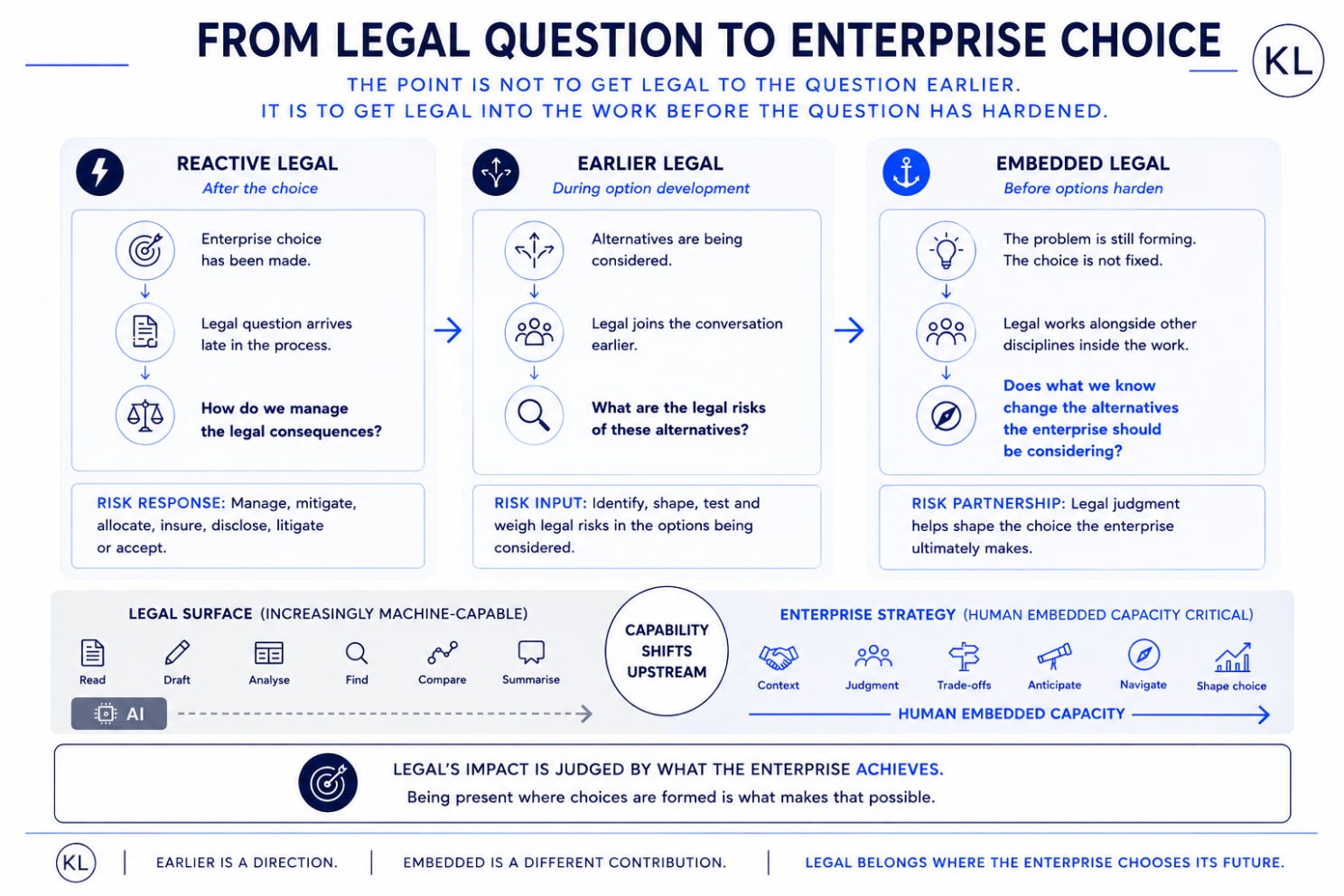
At its most reactive, legal asks: How do we manage the legal consequences of this decision?
Earlier legal involvement asks: What are the legal risks in the alternatives being considered?
But an embedded lawyer can sometimes ask: Does what we know change the alternatives the enterprise should be considering at all?
That is a different contribution.
Risk changes with it. Once a strategic choice has hardened, risk can be mitigated, allocated, insured, disclosed, litigated or accepted. While the choice can still move, risk can help shape the choice itself.
And this is where the fourth pattern from the first instalment becomes important. If legal is an enterprise resource, its contribution cannot ultimately be measured by the quality or quantity of legal work it produces. The first instalment put the test elsewhere: what the enterprise achieves where legal is embedded.
For the safety lawyer, the important output was not a better privilege memorandum. The enterprise outcome at stake was a safer system. For a lawyer participating in strategy, the measure is not how many legal risks she identifies. It is whether the enterprise makes a better choice because legal judgment was part of making it.
That is ultimately what embeddedness is for. Not changing the lawyer. Changing what the enterprise can do because the lawyer has been changed by being inside its work.
Legal judgment is no longer applied only to strategy after it has been formed. It becomes one of the disciplines from which strategy is formed.
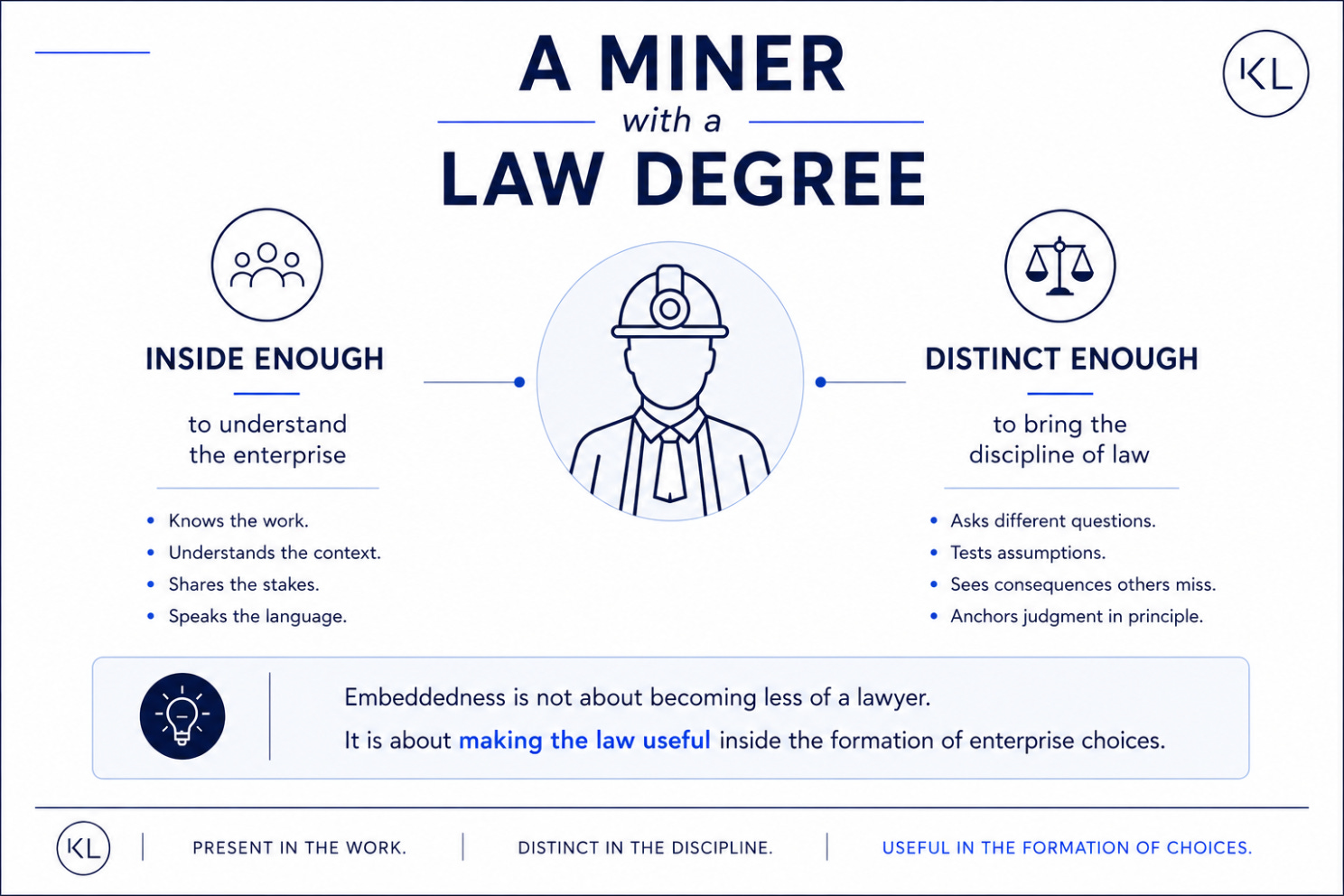
A miner with a law degree
Just before I retired from corporate life, in our final session together, one of my country lead lawyers was preparing for the next stage of her development. She was an exceptional lawyer who had come into mining from an unrelated, highly regulated industry. I asked where she most needed to grow: as a lawyer, as the leader of her team, or as a member of the executive committee?
Mining law worried her. But underneath that was a different anxiety. Not knowing enough about mining made her less confident about what she could contribute when the executive committee was discussing the business rather than the law.
I knew that feeling. My advice was not to start with more mining law.
Study copper mining.
Know the important mines and how they compare. Understand enough geology to know why the orebody matters. Learn about water, communities, logistics, labour, environment and economics. Understand why one mine performs differently from another, what constrains it and what gives it choices. And know as much as you reasonably can about the legal and permitting position of those mines.
The geologist should know more geology. The finance director should know more finance. The specialist external lawyer may know more about a particular field of law. The point is not to beat any of them at their disciplines. It is to understand enough of the enterprise for your discipline to become useful inside the formation of its choices.
My shorthand became simple.
You are a miner with a law degree.
In another enterprise, change the noun. Keep the discipline.
That last part matters. Embeddedness is not an invitation to dissolve into the business. The last instalment argued for calibrated presence, not maximum presence. Legal still needs enough distance to exercise independent judgment and enough professional depth to bring something distinctive to the conversation.
A miner without the law degree is not the objective. Nor is a lawyer standing at the surface of mining. The value lies in the combination.
In another enterprise, change the noun. A banker with a law degree. An investment manager with a law degree. Keep the discipline.
I should add one thing. When I returned to Cape Town, I started my LinkedIn series #MiningIsHuman for much the same reason. If part of my post-corporate life was going to involve working in and around mining, I wanted to keep learning about the industry, not simply its law.
And then there is AI
Which brings us back to the pressure with which this series began.
The first instalment deliberately rejected legal expertise as the defensible asset. Expertise is available outside, and AI can already hold more legal information than an in-house team.
AI will increasingly read the contracts, permits, board papers and investigations. It will retrieve history, compare positions, draft, analyse and find connections across a record at a scale no individual lawyer can match.
Good. Use it.
I would not build an in-house career around a list of things we hope machines will never do. That list will keep moving. Nor would I claim that participation creates some mysterious category of knowledge that machines can never reach. Much of what lawyers learn through experience can be recorded, reconstructed or inferred, and technology will become better at doing all three.
The more useful distinction is what participation does to judgment. It exposes the lawyer to consequence, interaction and context. It teaches what acquired significance when choices met reality. Repeated often enough, it creates a reference set against which the next problem is read — imperfectly, as my Latin American mistake shows. And because the lawyer remains inside the enterprise’s work, that changed judgment can be brought back into the next choice.
AI offers no immunity from that challenge. It sharpens it.
The more technology can do at the legal surface, the harder it becomes to justify spending scarce embedded human capacity there.
Use the machine at the surface. Use presence where participation can change what you learn and what the enterprise does.
What being inside is for
So perhaps I finally have a better answer to the Veteran.
“What do you know?”
Knowledge matters. His certainly did. But positional knowledge was not the whole opportunity I had been given by being inside. The larger opportunity was to participate deeply enough in the enterprise’s work for the enterprise itself to become part of my education.
To see choices become consequences. To learn what became significant and why. To see disciplines collide around the same problem. To carry one experience into another without assuming they were the same. To allow what I learned to change the question before reaching for the answer. And then to bring the discipline of law back into the next enterprise choice.
That is the loop.
The enterprise teaches the lawyer. The lawyer brings what she has learned back into the enterprise. Sometimes that changes what the enterprise does next.
That is the point.
And if AI continues to make the legal surface easier and cheaper to service, the question for an in-house lawyer becomes less comfortable, but perhaps more useful:
Are you merely inside the organisation, or are you sufficiently inside its work for it to be changing what you can contribute?
Because legal is an enterprise resource only to the extent that being inside ultimately changes the enterprise outcome.
A note on sources
This instalment is more experiential than the first two. Its central argument comes principally from things I saw while working inside legal functions: how participation in enterprise processes changed what lawyers noticed, what they learned from consequence, and what they were subsequently able to contribute.
There is a substantial literature around experiential and situated learning, tacit knowledge and professional judgment. I have deliberately not used it to build the argument here. Pattern Counsel started with practice, and this instalment stays particularly close to it.
The examples are therefore offered for what they are: experience from which I have tried to identify a pattern, rather than evidence that the pattern is universally true.
Continue the discussion
If this reading matches your own experience, or if it points somewhere different, I would value the exchange.
Kevin Lester is an independent counsel and thinking partner. He spent fifteen years as a Country Head of Legal and subsequently as General Counsel at Anglo American. He advises General Counsel, senior executives, and boards at kevinlester.co.za.
Subscribe to Kevin Lester
Please subscribe. There’s no cost. When you subscribe, you get free access to essays, stories and advisory notes on in-house legal, mining and regulated sectors, and the decisions that shape organisations under pressure. Always free.