


Originally published on LinkedIn. This work is AI-assisted - read about how I work.
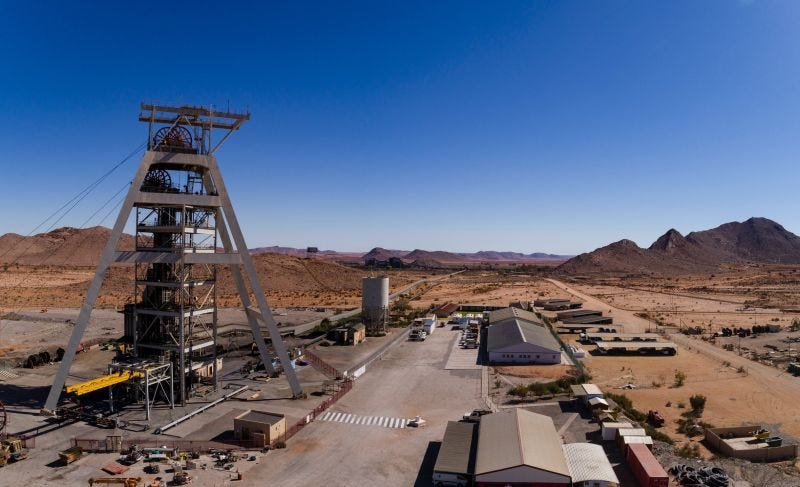
Inselbergs rise from a sea of red sand. The gravel plains between them carry sparse shrubs and little else. Bushmanland is probably the most inhospitable area in South Africa — and beneath it sits one of the most concentrated base metal packages on earth.
The Nama called this place ‡akeis. Colonial cartographers couldn’t hold the click consonant so it became Aggeneys, a town that didn’t exist until 1976, built because a mine needed people near it.
The mine came first. It always does out here.
Sixty-five kilometres west of Pofadder, four orebodies in a single 1.2 billion-year-old formation. Lead. Zinc. Copper. Silver. All in the same Bushmanland sequence.
Drilling began in 1970. Anglo American assembled the portfolio over subsequent decades — the Deeps and Swartberg underground operations at Black Mountain, and twenty kilometres east the Gamsberg deposit: 214 million tonnes at six percent zinc. One of the largest undeveloped zinc deposits on earth.
Anglo mined Black Mountain. But Gamsberg sat untouched for thirty years. A deposit that size, that remote, requiring that much capital — it needed zinc pricing, project finance, and the right buyer to align at the same moment. For Anglo, that moment never came.
In May 2010, Anglo sold the entire package — Black Mountain, Gamsberg, Lisheen in Ireland, and Skorpion in Namibia — to Vedanta Zinc International for US$1.338 billion. Exxaro Resources holds 24.4% of Black Mountain Mining as the BEE partner. For Vedanta this was never a small bet.
Vedanta commissioned Gamsberg in 2019. Phase 2 is now 94% complete. R7 billion approved. A second concentrator. When it doubles throughput — commissioning expected this quarter — Gamsberg will rank among the five largest zinc mines in the world.
That’s R7 billion on Phase 2 alone. On top of the acquisition. On top of Phase 1. The deposit Anglo found too remote and too capital-intensive is becoming one of the largest zinc operations on earth under the leadership of a South African engineer who started at Anglo, led the building of this mine for Vedanta, and now runs the whole Vedanta group.
Asked in 2014 what she hoped for, she said: to use mining to positively shape South Africa. Gamsberg was “the first step.”
Zinc is also the chemistry in the batteries the energy transition needs — zinc-air, zinc-ion, chemistries that exist today but not yet at scale. If they get there, Gamsberg will be one of very few deposits on earth with the resource to supply them for a generation.
The town of Aggeneys, including its schools and social infrastructure, exists because the mine does. For another half century.