


A note on this version. The original LinkedIn publication contained two substantive errors. It placed these three mines under Gold Fields ownership at some point in their history, which never happened, and attributed Sheba’s depth and grade record to the Royal Sheba orebody, which was in fact shallow and low-grade. The true depth producers are the Main Reef Complex and Zwartkoppie.
Both corrections came from readers who worked the ground directly: David Scott, a former senior geologist at Sheba, and Richard Hornsey and Roger Dixon, who worked through the Anglovaal and Metorex years. The exact year in which Fairview and ETC merged remains unresolved between two credible first-hand accounts and is flagged here rather than guessed at.
This work is AI-assisted—read about how I work.
It started before the Witwatersrand. A decade before.
In 1874, prospector Tom McLachlan found alluvial gold in the De Kaap Valley. Word crept out through disputed farm grants. By 1884 the rush had come.
Two Barber brothers and their cousin struck reef near Rimer’s Creek on 21 June 1884. A Gold Commissioner smashed a bottle of gin on the rock and proclaimed a township. Eight thousand people arrived within months. Two stock exchanges opened. In 1885, Edwin Bray found the Golden Quarry — 10km from Barberton as the crow flies, on the ground above what would become Sheba Mine. By 1887 the bubble had burst. Eureka City, 5km away, became a ghost town.
Three mines did not close.
The rock Bray was looking at had crystallised 3.5 billion years ago. The Barberton Greenstone Belt is the oldest substantially intact geological sequence on Earth. The gold sits in shear-zone quartz veins in ancient volcanic rock, not in riverbed gravels. That separates it from the Witwatersrand, which is 500 million years younger and works on a different principle entirely. The same mechanism runs north through Zimbabwe and into Tanzania. The same rock preserves microbial fossils 3.47 billion years old. UNESCO inscribed these mountains as a World Heritage Site in 2018.
The mines that stayed open in 1887 are still open.
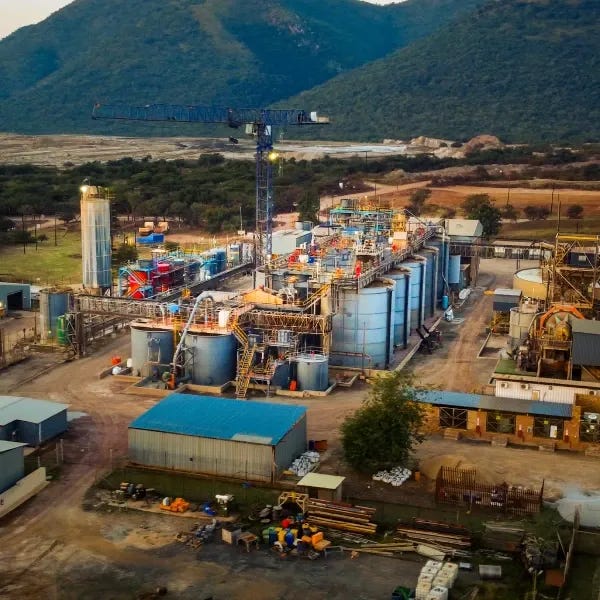
Sheba Mine, operating since 1885, now works past 1,000 metres. The depth producers are the Main Reef Complex and Zwartkoppie, both running at roughly 20 to 30 grams per tonne. Sheba’s geology carries at least five distinct styles of mineralisation, with local grades running past 1 oz/ton in places — a district that has never stopped surprising the geologists who work it.
Fairview Mine opened in 1887 and produces 49% of Barberton’s underground output. In 1986 it became the birthplace of the BIOX process: bacteria naturally present in the rock oxidise the sulphide minerals that lock gold away from ordinary leaching. Recovery rate: 98%. That process now runs on six continents.
New Consort has operated since 1887. Peer-reviewed literature calls it one of the oldest recognised orogenic gold deposits on Earth.
None of these three mines was ever a Gold Fields asset. The real chain runs through two separate corporate houses that only later converged. Fairview came down through Federale Mynbou, then General Mining, then Gencor — which commissioned BIOX at Fairview in 1986. Sheba and New Consort sat inside ETC, an Anglovaal Group holding from 1948, carried through the Avmin/Avgold structure in the 1990s. The two chains met when ETC and Fairview came together under one operating structure — the date is contested even among people who were there at the time, with informed accounts placing it anywhere from 1988 to 1998; this piece won’t assert a date it can’t stand behind. Metorex acquired the combined division from Avgold in June 2003. Barberton Mines (Pty) Ltd then operated with Shanduka holding 26%. Pan African Resources acquired 74% in 2007 and the remainder in 2009, and holds all three mines today, along with a tailings plant treating 100,000 tonnes of historical waste a month.
Gold Fields Limited enters this story only once, and only at arm’s length: after 1998, as licence holder for BIOX technology it inherited through the Gencor merger. Never an owner here.
FY2025 production: 83,772 ounces. Witwatersrand operations run at 1 to 2 grams per tonne. Barberton runs at 5.87 g/t. Total gold from this belt since the 1880s: roughly 11 million ounces. Life of mine: 23 more years, to 2051. An 8.75 MW solar plant at Fairview came online in 2024.
Nearly 150 years of production, and 23 more to come. The rock has not exhausted itself. It keeps offering, reef by reef, in the oldest gold mountains on Earth. No other district can say that.
A scientist reads microbial mats in chert on the Makhonjwa ridgeline, 3.47 billion years old. Six hundred metres away, a headgear turns. Both are reading the same rock.
Edwin Bray found gold here in 1885. The micro-organisms left their mark 3.47 billion years before him. The rock kept both.