


A different version of the same story was originally published on LinkedIn. This work is AI-assisted - read about how I work.
I have paused #MiningIsHuman for one week. More than one person has asked how I actually find these stories.
I am not a mining historian. I am a lawyer who has always been more interested in people and their stories than in the law itself. These stories start with fragments, not knowledge. I find facts that do not connect, and I chase them, obsessively, until they snap or lead somewhere.
This is one that led somewhere.
It is also, underneath the detective work, a story about how businesses grow up in small mining towns. They start small, built to serve whatever is directly in front of them. Most never go further than that. A few travel an enormous distance from where they started, and the lines connecting them back to mining capital turn out to run further, and stranger, than anyone setting up shop in a copper town could have guessed.
I will write about Springbok later this month, so I went looking for the lawyers who licensed those copper mines. I found almost nothing online and flagged it for further research. One name surfaced anyway, sideways: Joe Jowell, Springbok’s best-known lawyer. He arrives after copper mining was already established there, so he falls outside the search I was actually running. But I have known that name since childhood. My grandfather did business up and down the N7 and spoke of Jowell often.
Namaqualand had been a copper district since 1852, when the Blue Mine opened on the edge of Springbok, the first commercial mine in the country. By the 1920s, ownership had already passed through the Cape Copper Company and the Namaqua Copper Company. Both were gone within a decade of each other, the Cape Copper Company in 1919, the Namaqua Copper Company in 1931. The copper that did come out left on a narrow-gauge line the Cape Copper Company had built decades earlier between Port Nolloth and O’okiep, for that single purpose.
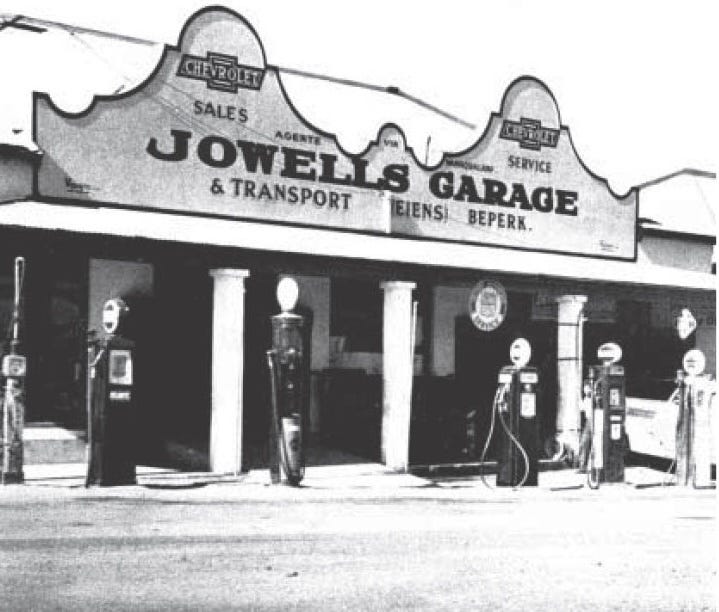
Jowell did not arrive as a lawyer with a transport sideline. He arrived as a Chevrolet sub-agent, taking over the Namaqualand dealership in 1929. In 1930, the South African Railways withdrew its unprofitable road motor service to the district, leaving the town without its supply line. Jowell converted an old Buick into a lorry to fill the gap. He traded as Jowells Garage and Transport.
The lorries found the railway’s weak point almost immediately, and the weak point was already there before Jowell arrived. By 1927 the South African Railways’ own mainline had reached Bitterfontein, a far shorter route to Cape Town than the old Port Nolloth line. Copper traffic on the Port Nolloth line had already stalled by 1928. Jowell’s lorries carried copper quartz the short distance to the new railhead at Bitterfontein instead, and two trucks could move what once took an entire train. Through the early 1930s, road haulage to Bitterfontein finished the job the new mainline had already started.
In 1937, the district changed hands again. Newmont, the American mining house, and American Metal Company acquired the mineral rights and assets of the old, by-then-defunct Cape and Namaqua concerns and incorporated the O’okiep Copper Company to develop them. Newmont held the controlling two-thirds interest. Production started in 1939, in time to make O’okiep a significant copper supplier to the Allied war effort. Newmont held the district until 1984, when it sold O’okiep to Gold Fields of South Africa.
Whether Jowells Transport hauled directly for Newmont’s new operation, I have not nailed down. The line of business and the decades of overlap in the same small town make it likely. I am treating it as an open question, not a settled fact. Despite his prominence in the town, Jowell himself was not the mines’ lawyer. There was another attorney who handled that work. I have his name. He is coming, in a later post.
What is not in question is what the transport business became. It listed on the Johannesburg Stock Exchange in 1955, while still trading under the Jowell name. Neil and Cecil, Joe’s sons, joined in 1956 and 1958. In 1967 the company took the name it is still known by: Transport and Engineering Investment Corporation, Trencor.
The diversification came in stages. Trailer manufacturing in 1969 and 1970, through the acquisition of Henred Trailer Manufacturing, later merged with Fruehauf South Africa to form Henred-Fruehauf. Marine cargo containers from the late 1970s, built mainly for the export market, then folding flat-rack containers and stainless steel tank containers. In 1979, Trencor took its most consequential step: it began financing the sale of containers on long-term credit. That financing arm became Textainer.
Textainer grew into one of the world’s largest container leasing companies, eventually trading on the New York Stock Exchange with a secondary listing on the JSE. Springbok to New York, in under a century.
It did not last. In March 2024, the private equity firm Stonepeak bought Textainer outright for $50 a share, roughly $7.4 billion in enterprise value, and delisted it from both the NYSE and the JSE. Trencor, which still held a 47.78% stake by then, was cashed out along with every other shareholder. Trencor itself followed it down. It spent the next year as a cash shell, paid out a final special dividend, and was delisted from the JSE on 5 August 2025. It entered voluntary liquidation the following day. The company that began as a Chevrolet sub-agency filling a gap left by a withdrawn railway service no longer exists in any form. What it built still does: Textainer’s fleet, more than four million containers, is still moving freight around the world, under new owners.
There is a second thread here I have not pulled yet. Newmont took a 25% founding stake in the Anglo American Corporation of South Africa in 1917, four years before Newmont itself was formally incorporated, placing it near the centre of early Witwatersrand gold capital. Decades later, the same company controlled the Springbok copper mines for almost half a century. Two unlikely lines, Newmont and Textainer, both pass through the same small Namaqualand district in the middle of the twentieth century. Both ended up listed in New York. I did not expect that when I started.
This is how these stories get built. A narrow question about who licensed Namaqualand’s mines opens onto a far wider circuit of capital: Namaqualand, the Witwatersrand, London, New York. I do not start with knowledge. I start with curiosity, and I connect dots that often feel tenuous, even to me, and follow them anyway. Sometimes they reveal something. More often they leave me with more questions. Either way, the search feels like working an ore body: following traces that may or may not lead anywhere.
Next week, 6 January, #MiningIsHuman moves to a Tuesday slot. We take a hard look at the emergence of an industrial supply chain to power mining. We go looking at dynamite factories.