


Originally published on LinkedIn. This work is AI-assisted - read about how I work.
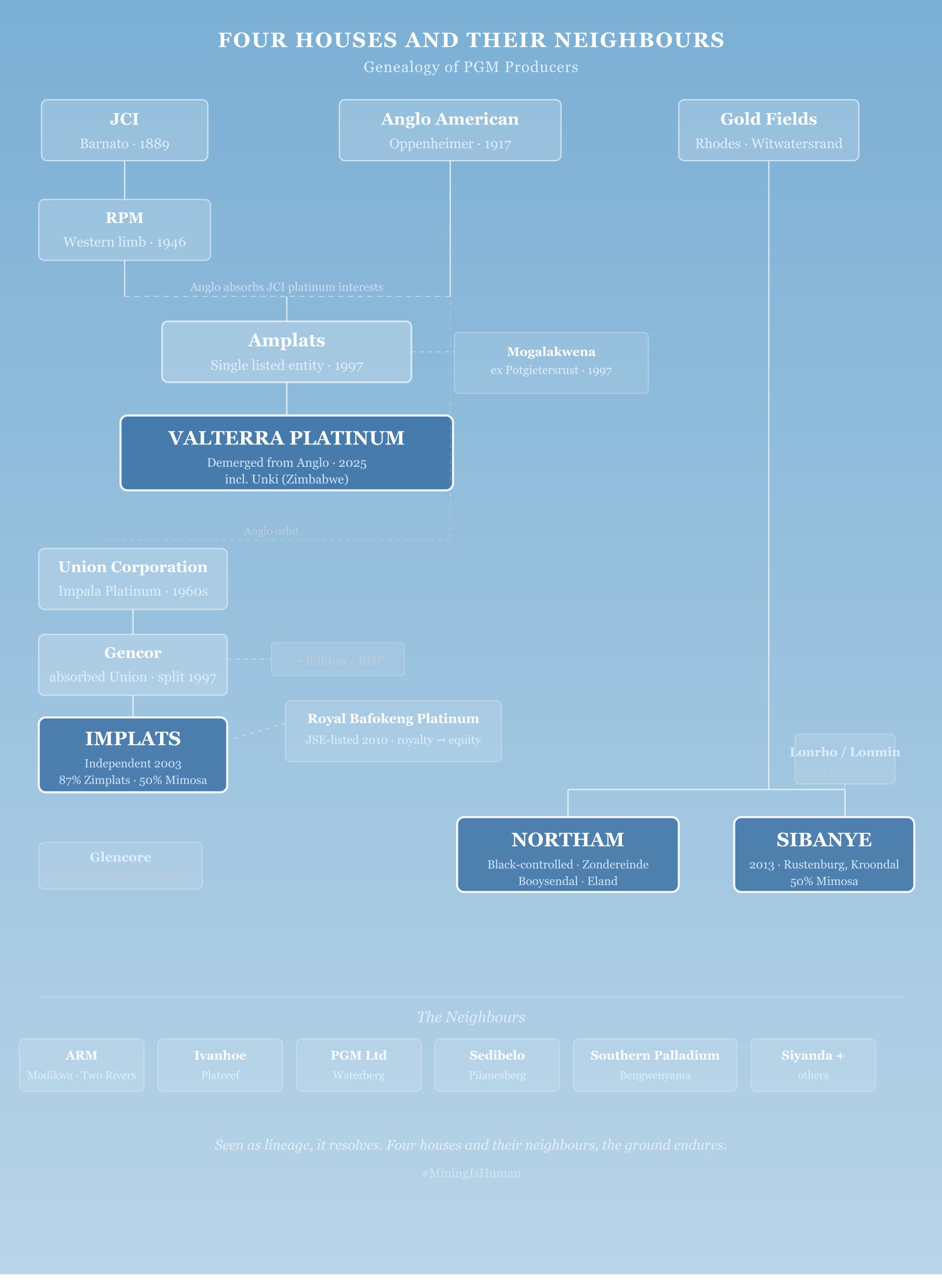
While Kgosi Mogatle’s Bafokeng men worked the Kimberley diamond fields, the genealogy of PGM producers formed above them. Barnato's JCI and Rhodes' Gold Fields staked rival claims on the Witwatersrand; Anglo American emerged as the Oppenheimers' answer to both. Union Corporation would later produce a 4th line. They seeded today's PGM producers.
Southern Africa's PGM belt carries more history than most can hold: shafts, smelters, tailings dams, strikes, closures. The supercycle transformed a handful of operations into a 20 mine sprawl. What remains resolves as lineage, not map.
Valterra Platinum was cut from Anglo American in 2025, heir to ground built over a century. Behind it: Amplats, constituted as a single listed entity by 1997 when JCI unbundled its platinum interests — the result of Anglo's long absorption of the Barnato house. Before JCI: RPM on the western limb. Later, under Anglo, Mogalakwena — the world's largest open-pit PGM mine — joined in 1997, with the Potgietersrust Platinums acquisition. Valterra also holds Unki on Zimbabwe's Selukwe subchamber.
Implats anchors the western limb. Union Corporation created Impala Platinum in the 1960s on Bafokeng ground north of Rustenburg. Gencor absorbed Union, then restructured non-precious metals to Billiton. The rest wound down after 2003, demerging Implats to shareholders. Implats emerged independent. In 2023, it absorbed Royal Bafokeng Platinum — the Bafokeng nation's JSE-listed PGM producer, built from royalty rights. In Zimbabwe, Implats holds 87% of Zimplats — ground that passed through Delta Gold, BHP's Hartley, and the Mhondoro joint venture — and 50% of Mimosa, which passed through Union Carbide and Zimasco before Implats took its half.
Northam built quietly. Zondereinde was the foothold; Booysendal and Eland followed. It emerged from Gold Fields and stayed focused — a black-controlled integrated producer assembled through patient accumulation. It remains a purely Bushveld house.
Another house was Lonrho, now defunct. Its assets passed into the youngest house, Sibanye.
Sibanye-Stillwater is the younger Gold Fields sibling and the most consequential consolidator on the belt. Formed in 2013 from Gold Fields' unbundled South African gold mines, it took Amplats' Rustenburg and absorbed Kroondal. In Zimbabwe, Sibanye holds the other 50% of Mimosa, picked up when it replaced Aquarius in 2016.
Glencore's PGM interests dispersed without consolidating into a house.
The neighbours: ARM at Modikwa and Two Rivers, Platinum Group Metals at Waterberg, Ivanhoe at Platreef, Sedibelo in the Pilanesberg, Southern Palladium at Bengwenyama, Siyanda and others — parts of an inheritance long established.
Seen from surface infrastructure, the PGM belt appears bewildering. Seen as lineage, it resolves. Four houses and their neighbours, the ground endures.