Pattern Counsel is written for General Counsel, Chief Legal Officers and their teams — and for the law firms, legal operations professionals and technology providers who work alongside them. Originally published on LinkedIn. This work is AI-assisted—read about how I work.
Pattern Counsel reflects my vision of how in-house legal functions could work. Many General Counsel will see it differently—and in the coming months, I’ll invite some of them to share their own visions.
Introduction
Being inside is two things, not one.
A position in the enterprise: where legal sits, who it reports to, which rooms it is allowed into. And a presence across the enterprise’s work: whether legal is there across the phases where the work creates, manifests or exposes legal risk—or only in the phases into which it is invited. Most functions win the seat and assume it guarantees that presence. It doesn’t.
The first instalment, last month, put the model plainly. Legal is an enterprise resource, not a service provider. It compounds value through embeddedness, in the business and across the phases of work that demand it. It trades replicable work out to a governed process. And it is judged by what the enterprise achieves where legal is embedded, not by what legal produces.
One of those four patterns—that value compounds only from inside—depended on when the lawyer was present, not where she sat. I offered it as a pattern I’d noticed, not a theory I’d built. This instalment gives that pattern a method, with the same caution.
Two words, kept apart
The argument depends on separating two things the profession often treats as one.
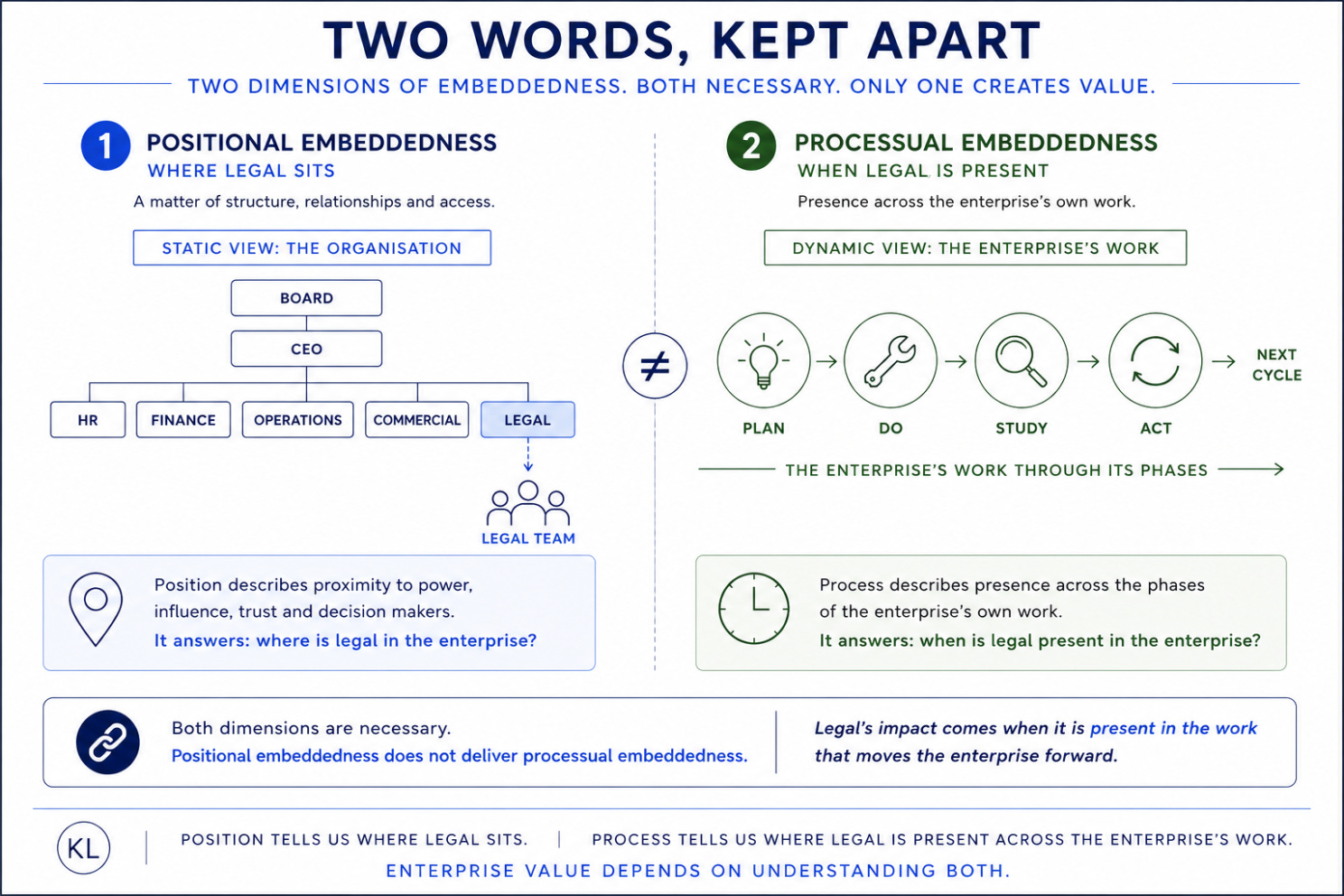
Positional embeddedness is where legal sits in the enterprise: its place on the org chart, its reporting line and its seat at the table. It is about structure and relationships—who trusts legal, who brings it into the work and how close it is to the people making decisions.
Processual embeddedness is legal’s presence across the enterprise’s work. Enterprise work moves through phases. However those phases are described, one of the central insights of modern management is that work unfolds as a process. Processual embeddedness means having legal present in the phases where that work creates legal risk.
Position tells us where legal sits. Process tells us when legal is present across the enterprise’s work.
To be clear from the outset, this essay is not about legal’s process. The processes discussed here belong to the enterprise. Legal will have processes of its own, but it must design them around the enterprise’s work, not mistake them for that work. When the enterprise must hand its work over to a separate legal process, legal remains outside the work it seeks to shape.
Both dimensions are necessary. Positional embeddedness does not deliver processual embeddedness.
Three answers to where
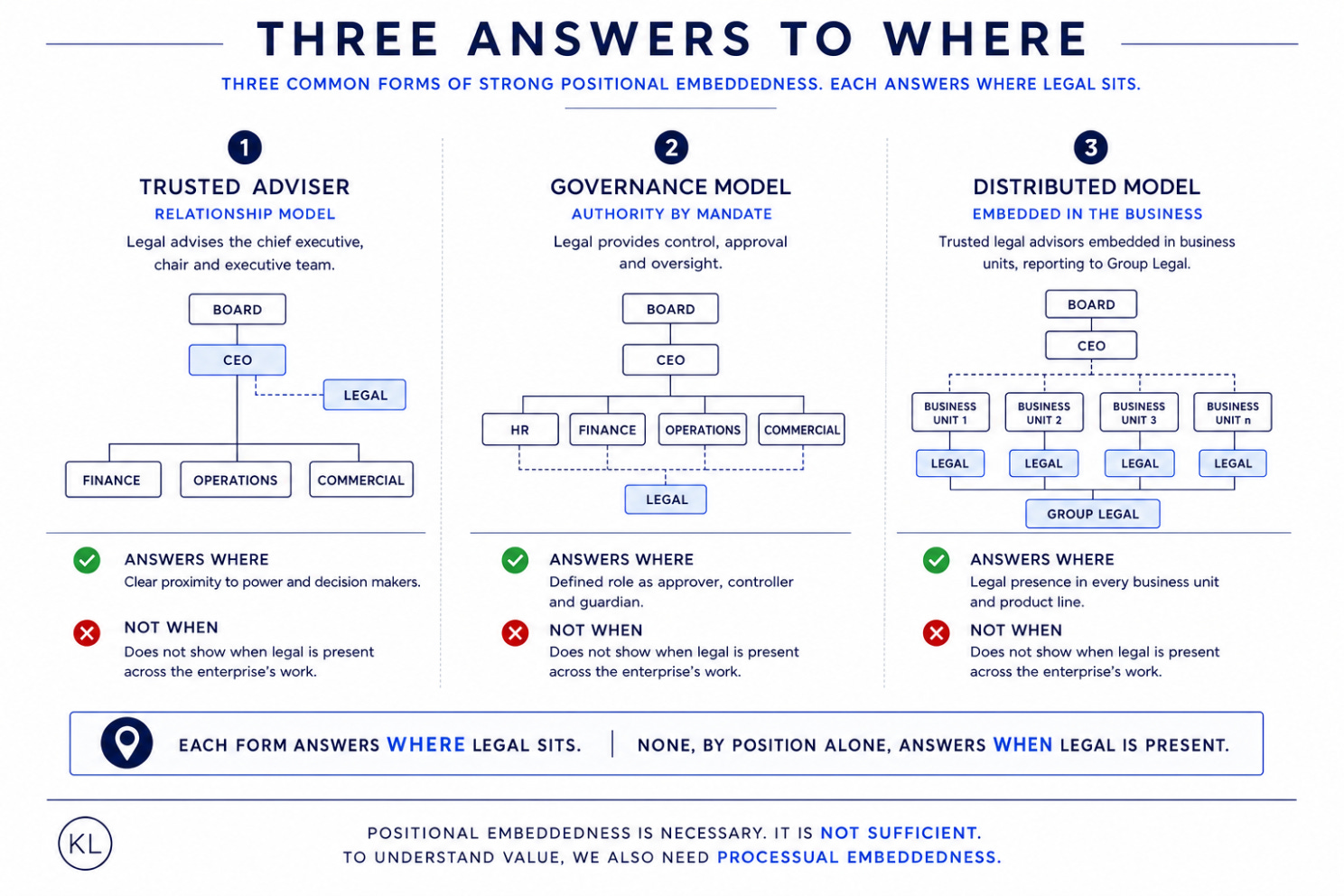
In my experience, strong positional embeddedness takes three common, often overlapping forms.
The trusted advisor. The General Counsel as counsel to the chief executive, the chair and the executive team. Influence through relationship and proximity to power.
The governance model. Legal placed at the enterprise’s formal gates: the approver of contracts, the keeper of the delegation framework and the desk to which trouble is brought. Authority by mandate rather than relationship.
And the distributed model. From my own experience, this is most developed in financial services. Trusted advisors embedded in business units or product lines, reporting to a group General Counsel who advises the group chief executive. It is the strongest answer the positional axis has produced: a lawyer in every lane, close to every business and senior enough to be heard.
When I first encountered the distributed model during a visit to a long-term insurer in 2015, I was convinced it was the whole answer. It is not. A function can place a trusted lawyer in every unit and still bring each of them in only at execution, after the choices shaping the risk have been made. Structurally present. Temporally absent. Seating a lawyer inside the business settles where she sits, not when she enters the work.
Another common arrangement is a Head of Legal reporting to the CFO. This is a positionally constrained answer to where. Legal sits a step removed from the chief executive and the executive team, with access often mediated through another function. Processual weakness is not inevitable, but it becomes more likely: the further legal sits from those directing the work, the more likely it is to enter only when invited.
All of these arrangements answer where legal sits. None, by position alone, answers when legal is present across the work.
The experiment already ran
Here is the helpful part. Legal is not the first support function asked to move from the back office into the business. Finance did it. HR did it. Risk and compliance did it. Each developed a model, tested it at scale and left a record legal can learn from.
Finance developed business partnering. HR developed the HR business partner model. Risk and compliance developed the three lines model. Each sought, in different ways, to move closer to the business.
In each case, the position was secured but the value did not always follow. The literature on HR business partnering is particularly blunt: the model has often fallen short of its promise. A recurring reason is that position did not become presence. Being at the table is not the same as being in the work the table decides.
This is not peculiar to legal, or to mining. It is what happens when a function treats the seat as the destination.
Finance, HR and risk won the seat. The seat was not the thing.
The lament, and the layer under it
Every in-house lawyer has made the same complaint. I wish they’d involved me earlier.
It is a real signal. The lawyer has felt, without quite naming it, that the work has a shape and that the timing of legal’s presence affects whether it can add genuine value or prevent its loss. Legal keeps arriving at the wrong point in that shape—often after the choices that mattered have been made. That is the processual axis surfacing.
But the complaint turns that insight into a blanket prescription: bring legal in earlier and involve it more. Neither is always the right answer. Sometimes the answer is less legal involvement at execution and more at review. Sometimes it is no involvement at all in a phase legal has attended only out of habit.
Earlier is a direction, not a diagnosis. It tells us to change the timing, but not which phase requires legal’s presence.
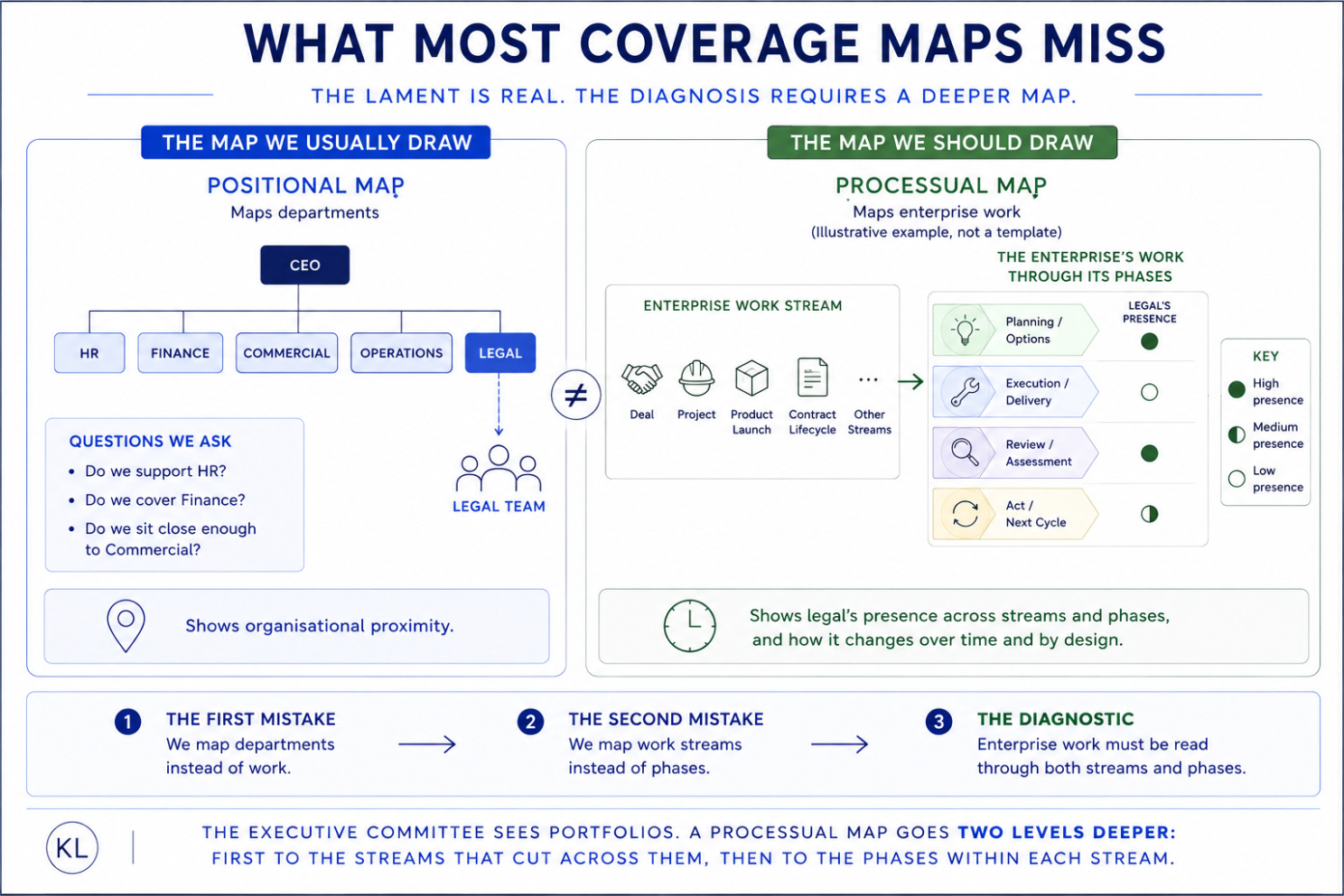
There is a subtler error beneath this instinct, and it is where most coverage mapping goes wrong. When a General Counsel maps the function’s coverage, the map is almost always drawn against the org chart. Do we support HR? Do we cover business development? That is the positional instinct applied to a processual question. It produces a picture of which departments legal is near, rather than of the enterprise’s work in which legal is present.
The load-bearing work does not stay within departmental portfolios. It moves through streams that cut across them: a single transaction may draw in finance, commercial, tax and operations at once. Each stream, in turn, moves through phases. The executive committee sees portfolios. A processual map must go two levels deeper: first to the streams that cross them, and then to the phases within each stream. Most coverage maps never reach that second level.
How the work is shaped
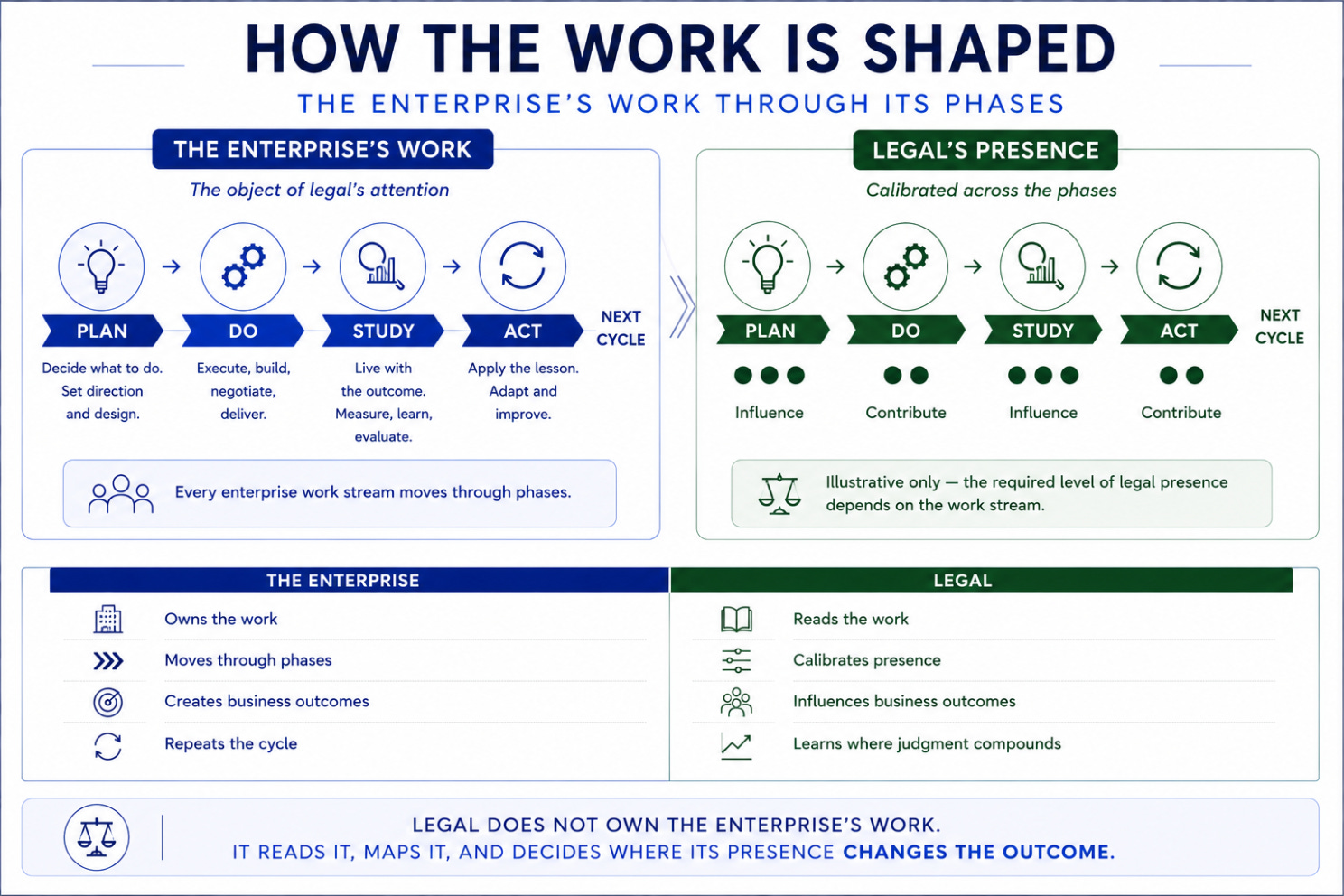
A stream of enterprise work has a shape, and the shape has phases. Deming gave a clean version, building on Shewhart before him: plan, do, study, act, a loop in which acting on the lesson becomes the next plan. Last time I ran on three phases, planning, execution and review. This is the same shape read closer. Study and Act separate review into its two real parts: judging what happened and carrying that judgment into the next plan. The distinction matters because carrying the lesson forward is where the compounding occurs.
I use Deming because the cycle is clean, not because it is the only one; a gated model or a lifecycle model would do the same job. The claim is not about Deming. It is about reading the enterprise’s own work into phases so that, at each one, you can ask a single question. Does this phase expose, manifest or create legal risk, and am I present where it matters?
Legal’s task here is rarely to run the work. It is to read it: to understand how it moves through its phases, to recognise where legal risk is created, manifested and carried forward, and to decide where its own presence changes the outcome. That is the whole difference.
Take the work legal is most certain it owns. A major commercial contract.
Plan: The enterprise plans it before there is anything to draft. The commercial team decides to enter the arrangement, settles on the counterparty, fixes the shape in principle: price, volume, duration, exclusivity, the terms of exit. No clause exists yet. Every consequential legal risk does. Whether the counterparty can be relied on to perform. Whether the structure trips merger control. What dependence is being locked in, and on whom. Decided in that room, by non-lawyers, before a word is drafted. This is where being inside pays out. The lawyer who lived the last three deals of this shape knows which counterparty defaulted, where the regulator pressed, what the exclusivity cost when the market turned. She is one of the few whose presence changes the outcome. Not drafting. Interrogating the structure while it is still soft enough to move.
Do: Then the enterprise does it. The deal is papered, negotiated, closed. Here legal genuinely produces, and the drafting is real, skilled work. Here is the trap. This is the one phase where legal makes something, so it is the phase legal mistakes for the whole stream. The risk is manifested here, allocated by the words on the page, but it is barely created here, because the room to create it closed at Plan. Legal is one of many now: commercial holds the terms, finance holds the model, legal holds the paper. Being the drafter at execution tells you nothing about whether anyone was present when the exposure was set. Most functions arrive at this phase and call it involvement.
Study: Then the enterprise studies what it signed, if anyone does. The contract runs. Clauses are invoked, or they leak. The counterparty behaves as the paper assumed, or it does not. The pricing does something when the market moves. This is the business living with its own decision, and reading it with legal eyes is work only someone who was inside the deal can do. One of the few again. Most functions skip it. Close the deal, move to the next.
Act: Then the enterprise acts. The lesson carries into the next arrangement of this shape: the template amended, the position for this kind of counterparty improved, the next deal begun from higher ground. The compounding is the enterprise’s, not legal’s, and legal’s presence at Study is what feeds the better Plan. Act into Plan is where the line becomes a loop, and the loop is the whole mechanism.
A single contract does not loop; it is signed once and done. The class of contract loops. Supply agreements, offtakes and outsourcing deals recur, and the compounding lives at the level of the type, not the instrument. That is where the template and the playbook accumulate.
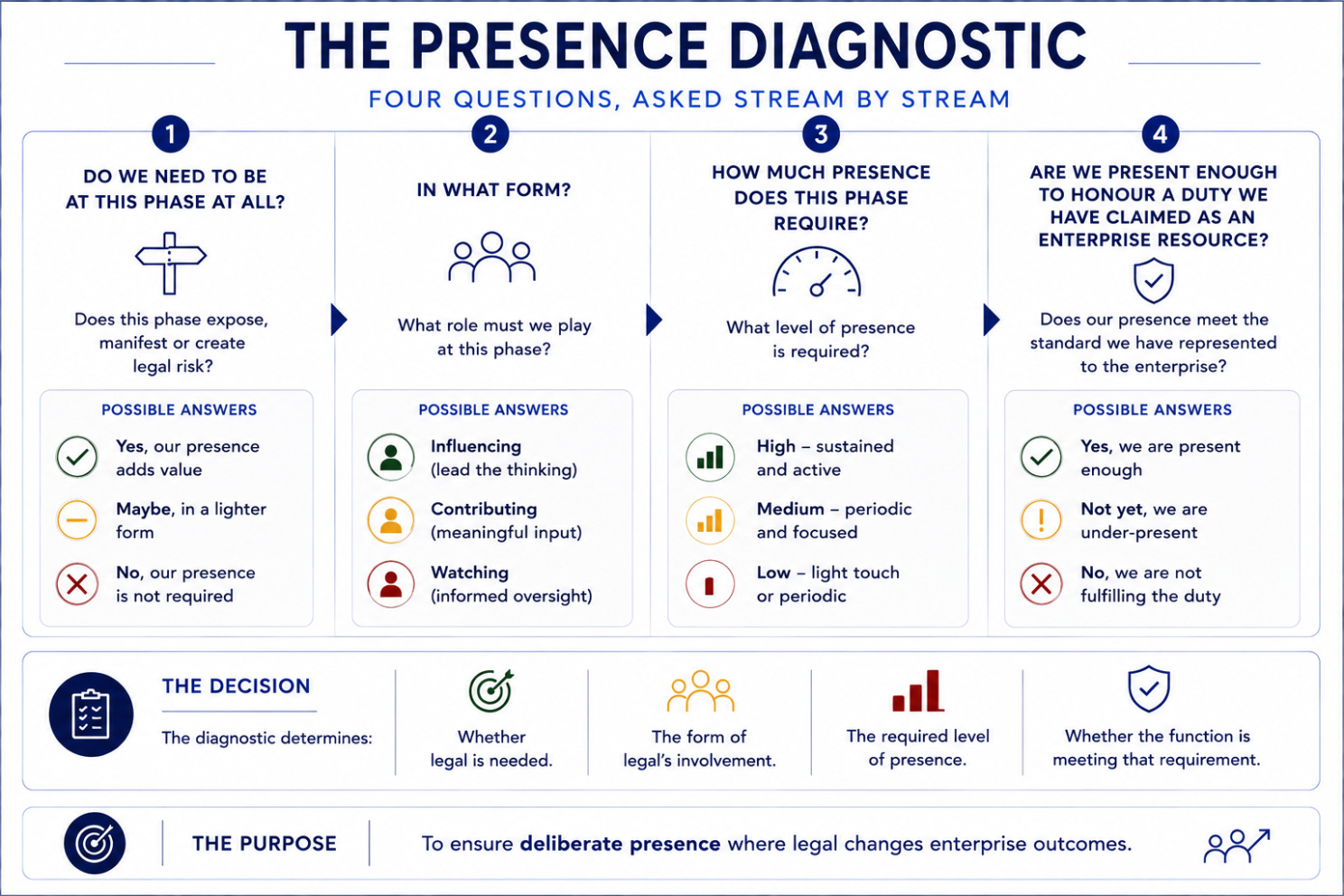
The result is not another legal framework. It is a diagnostic for reading the enterprise’s work: four questions, asked stream by stream.
Do we need to be at this phase at all?
In what form: leading, influencing, contributing, or only watching?
How much legal presence does this phase demand?
Are we present enough to fulfil the role we claim as an enterprise resource?
The diagnostic has only one purpose. It tells you where legal presence is genuinely demanded and where it is merely habitual. You do not yet need to decide what to release. You now know where to look.
The questions are allowed to answer no. They are allowed to answer less. A function present everywhere at full weight is not the ideal. It is over-embedded, too close to the business to see it clearly, and its judgment suffers as a result. Calibration is not a concession to a tight headcount. It is the correct shape.
The same shape, without a mine in it
The pattern is not mining’s. It is not the contract’s either. A regulatory affairs specialist in a pharmaceutical company works through the same pattern. A drug moves through a gated lifecycle: discovery, preclinical, trials, submission, approval, and the long tail of market surveillance, each submission resting on the documented history of the one before it. The specialist who was present when the early regulatory strategy was set reads the later submission with knowledge that is not in the file: what the agency signalled and never wrote down, why a design choice was made, where the last application met resistance. One of the few at the front. One of many in the machinery of a filing. One of the few again when the regulator responds and the next submission is shaped. No tailings dam in sight. The same pattern exactly.
A deliberate act
None of this happens by good intention. A function does not drift into presence across the phases that matter. It maps the enterprise’s work and designs its presence against it, or it arrives where habit and invitation put it.
For a mature function, the mapping is an audit, and an uncomfortable one: going stream by stream and asking honestly where we arrive against where the value accrues. Most functions that run it find the same answer. We arrive at Do—present for execution across almost everything and for planning across almost nothing—and we have been calling the execution half coverage. The diagnostic turns a vague unease into a specific question. The map itself is already valuable. Most functions have never seen their work arranged this way.
Designing that presence from the beginning is different work altogether. It belongs to function design rather than function audit, and it is the subject of a later instalment.
Presence across the enterprise’s work is designed, or it is accidental. There is no third case.
What it costs, and what pays for it
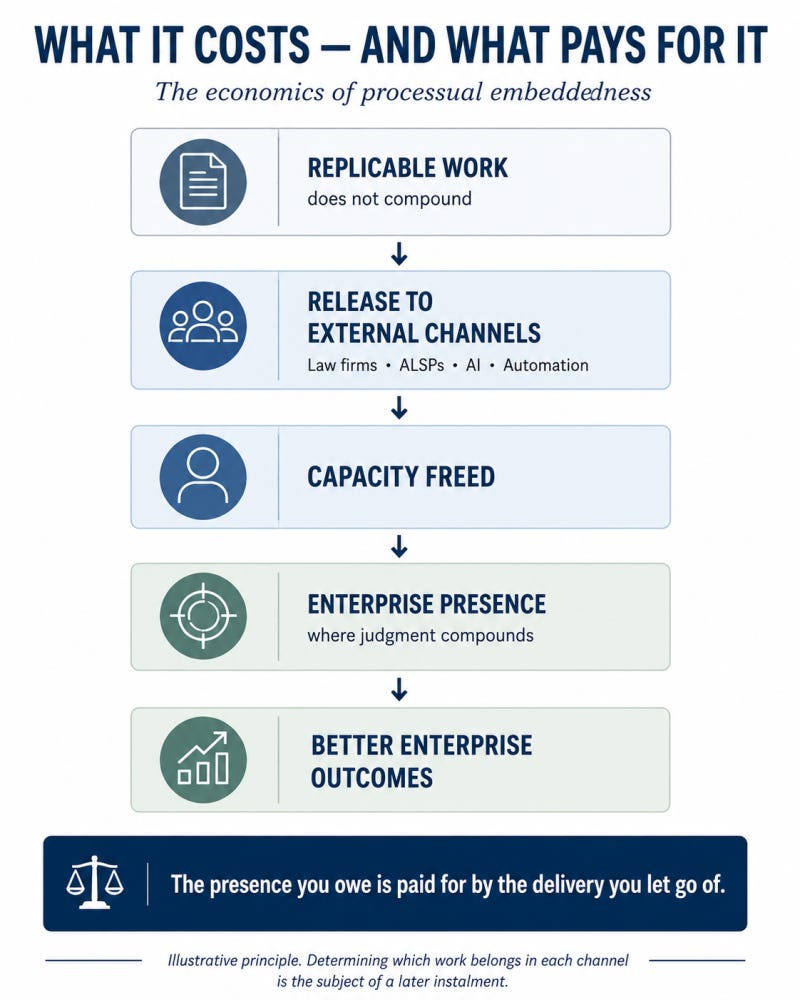
I will not pretend this is free. Reading every load-bearing stream at the level of its phases, then ensuring legal is present where judgment compounds, is more work than turning up at execution and drafting well. And it lands at the worst possible moment, when the enterprise is asking legal to cost less, not do more.
The additional work is not overhead. It is what makes legal an enterprise resource, and it is funded the only way it can be: by releasing the replicable work that does not compound, the work an external channel, properly instructed, would do just as well.
The presence you owe is paid for by the delivery you let go of.
Which work belongs in each channel, and how you decide it without losing hold of what matters, is a later question. It is the same diagnostic turned inward, onto legal’s own work. This instalment has used it to read the enterprise; a later one will use it to redesign the function itself.
Concluding this instalment
This is the discipline the series set out to take up: where presence is demanded, and where it isn’t.
Being inside is two things. A position, and a presence. Position is necessary and routinely mistaken for sufficient. Finance, HR and risk each won it and learned the hard way that it did not carry the presence, and legal is about to be asked the same question under AI’s pressure. The method for answering is not a framework to adopt. It is a way of reading the enterprise’s own work into phases and asking, stream by stream, where legal risk is made and whether the function is there when it is. Designed presence, or accidental. There is no third case.
Why presence compounds at all—what kind of knowledge being inside the work produces that being outside it cannot—is the subject of the next instalment.
A note on sources
The word embedded is not mine, and I have tried not to use it loosely. I did not arrive at the idea through economic sociology. I arrived at it through practice, and only later found that others had been working on embeddedness for decades. Looking back, it echoes Mark Granovetter’s work on how economic action is embedded in social relationships, and Brian Uzzi’s work on how those relationships affect organisational performance. Uzzi also shows that embeddedness has limits: beyond a point, it can impair rather than improve judgment. That finding supports this instalment’s argument for calibrated rather than maximum presence.
That legal makes its value upstream, before the problem rather than after, is the heart of the Nordic School of Proactive Law, and of Helena Haapio’s work in particular. It gave a rigorous vocabulary to something I had already been watching.
I learned most from the functions that made this journey before legal: finance business partnering, Dave Ulrich’s HR business partner model and the honest post-mortems on it, and the three lines model in risk. Their failures taught me more than their successes.
Deming and Shewhart supplied the cycle. I borrowed it as a way of reading enterprise work, not as a quality-management method.
One honest gap remains. I could not find a study that puts a number on the cost of late legal involvement in corporate decision-making. The proactive-law literature makes the case in principle; the analogue functions show the pattern in practice; legal’s own number is not yet in, and I will not pretend otherwise.
Continue the discussion
If this reading matches your own experience, or if it points somewhere different, I would value the exchange.
Kevin Lester is an independent counsel and thinking partner. He spent fifteen years as a Country Head of Legal and subsequently as General Counsel at Anglo American. He advises General Counsel, senior executives, and boards at kevinlester.co.za.
Spot on, Kevin—that distinction between position and presence is crucial. Getting a seat in the room is table stakes; being integrated early enough in the work stream to shape outcomes rather than just manage downside is where an in-house team proves true enterprise value. But achieving that presence often comes down to business literacy—we can't wait for an invitation, nor can we demand one, unless our team deeply understands the operational mechanics of the business well enough to add value before legal risk explicitly surfaces.




Spot on, Kevin—that distinction between position and presence is crucial. Getting a seat in the room is table stakes; being integrated early enough in the work stream to shape outcomes rather than just manage downside is where an in-house team proves true enterprise value. But achieving that presence often comes down to business literacy—we can't wait for an invitation, nor can we demand one, unless our team deeply understands the operational mechanics of the business well enough to add value before legal risk explicitly surfaces.