


This story is exclusively available on Substack. This work is AI-assisted - read about how I work.
Today, southern African gold is almost inseparable from the Witwatersrand. Its mines built Johannesburg and produced extraordinary value, but 1886 was not the beginning. It was the industrial chapter of a regional history that archaeology is only gradually bringing back into view.
Between about 1250 and 1290, a goldworker at Mapungubwe covered a carved wooden rhinoceros with hammered gold foil. The object weighs 37.4 g and predates the Witwatersrand goldfields by about six centuries.
Mapungubwe was a political and trading centre, not a mine. Its gold probably came from rivers and reefs across the wider Limpopo region, where miners washed river gravel and crushed reef quartz. Many also farmed, planting with the rains and turning to gold in the dry season. At Chumnungwa in Mberengwa, archaeologists found a clay mould for gold beads and a crucible fragment still holding a droplet of gold. The miners’ names have disappeared, but their work has not.
Follow the metal in the other direction and the story runs east. Gold moved by relay from producers to inland markets, through rulers and merchants, and towards the coast. Mapungubwe flourished from about 1220 to 1300; Great Zimbabwe reached its height from about 1200 to 1450; Khami and Mutapa followed. Gold was never their only source of wealth, because cattle and grain mattered too, but it connected these changing centres to a commercial system that reached far beyond them.
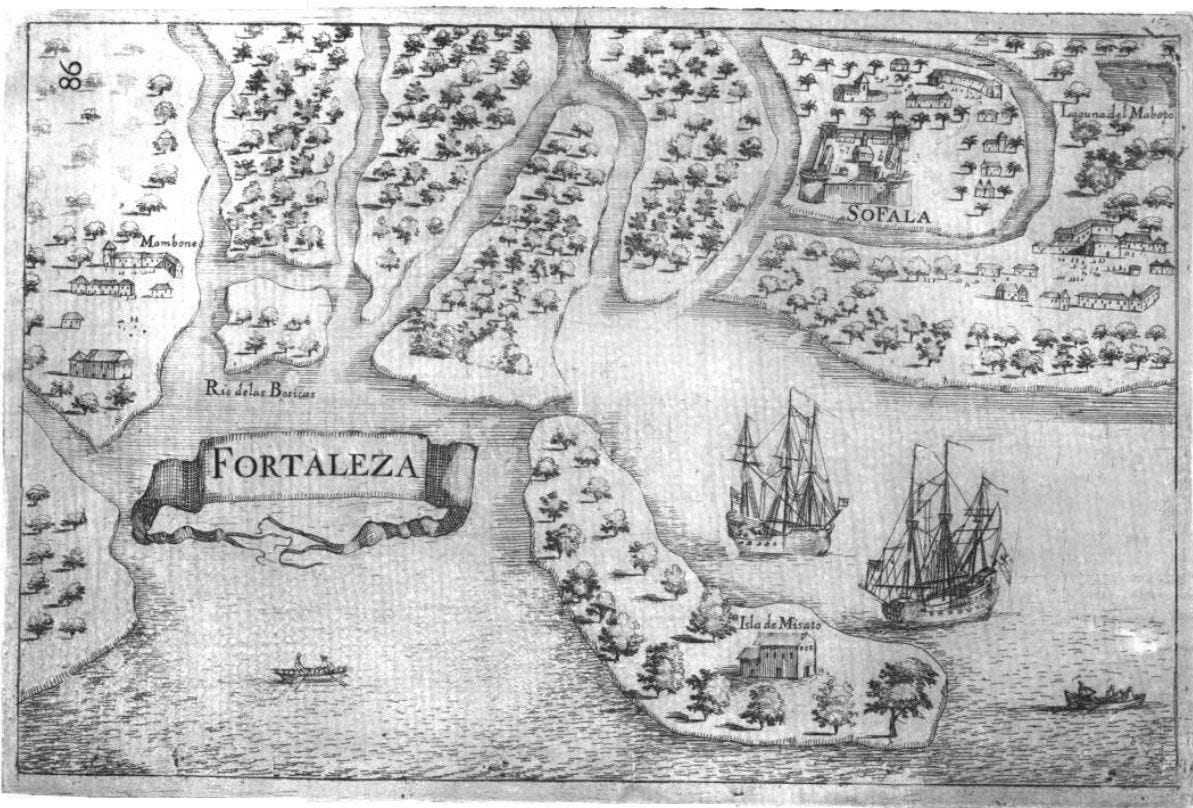
Sofala became a major outlet. In 1331, a merchant at Kilwa told Ibn Battuta that gold dust reached the port from a country inland. Kilwa became the leading Swahili intermediary, although its control was neither continuous nor exclusive.
From Kilwa, the commercial network extended to Gujarat in India, Oman, Aden and the Persian Gulf, with Aden linking it to the Red Sea and Cairo. Gold helped pay for Indian cloth, beads and other return cargoes. Chinese celadon reached Mapungubwe, while Chinese and Persian ceramics and coins from Kilwa reached Great Zimbabwe. We cannot trace a particular parcel of plateau gold to China, but the objects found inland make the scale of the Indian Ocean system visible.
When the Portuguese established themselves at Sofala in 1505, they did not open this road; they entered one that was already old. The following year, Diogo de Alcáçova told King Manuel that gold reached the port from an inland kingdom and claimed that access to the diggings depended on the ruler’s permission.
Gold has been worked around the Limpopo for at least 800 years, while the Witwatersrand has been mined for 140. The Rand was not South Central Africa’s first gold road. It was a much later industrial chapter in the region’s long relationship with gold.