


Originally published on LinkedIn on 13 October 2026. This work is AI-assisted - read about how I work.
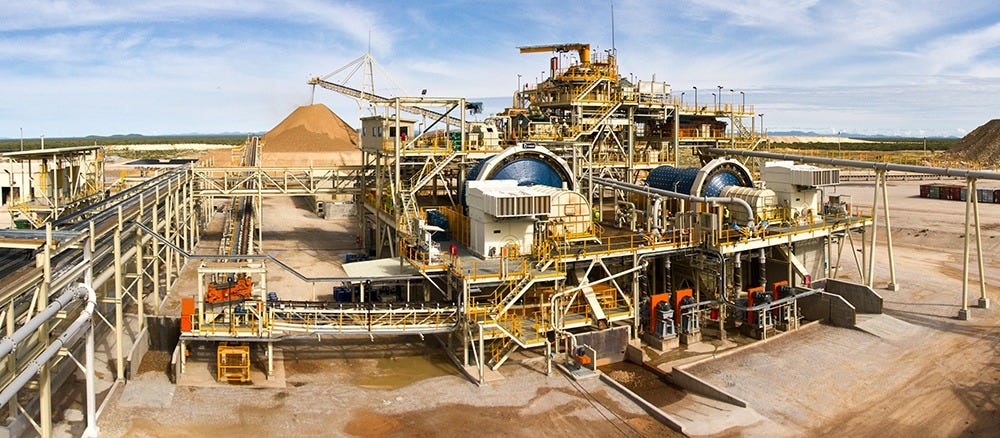
In 2025, its last open-pit year, Otjikoto produced 199,139 oz of gold. By the first half of 2026, the pit was closed, but the mine was not. Wolfshag underground ore and stockpiles produced another 47,967 oz, while the plant that milled 3.44 Mt in 2025 kept running.
Gold was not what first brought drill rigs here. In 1998 and 1999, Avdale Namibia was exploring for base metals when it drilled a 9 km magnetic anomaly beneath calcrete and hit visible gold. B2Gold Corp. filings record no known earlier gold or base-metal production on the property. The deposit sits in the Pan-African Damara Belt, deformed roughly 580–500 million years ago.
Otjikoto lies south of the later veterinary boundary, within the wider central Namibian area administered as the colonial Police Zone.
Ovaherero pastoralists used the wider Waterberg–Otjozondjupa region; Damara and San communities also lived there. Colonial proclamations in 1906 and 1907 expropriated Ovaherero and named Nama groups. By 1913 German settlers held 1,331 farms and about 90% of the cattle in the Police Zone. The corporate and technical records reviewed do not identify the original grants or provide a complete prior-title chain for the five farms now consolidated in B2Gold Namibia.
B2Gold acquired Otjikoto through its merger with Auryx Gold Corp. in December 2011. Namibia granted mining licence ML 169 in December 2012. Groundbreaking followed on 26 April 2013. First gold came on 11 December 2014, about 19 months later.
B2Gold owns 90% of Otjikoto through B2Gold Namibia. Namibian empowerment partner EVI holds 10%.
By then, Otjikoto had already found what came next.
Wolfshag, discovered in 2012, delivered its first stope ore at the end of November 2022 and is expected to run into 2027. In 2022, deeper drilling guided by three-dimensional magnetic modelling found Antelope, 3–4 km from the original pit. B2Gold approved development on 15 September 2025. Its Springbok zone carries an inferred mineral resource of about 390,000 oz.
The transition has a human cost. B2Gold reported that 98.5% of its Namibia employees were Namibian nationals in 2024. As open-pit mining ended, employee headcount fell to 399 by the end of 2025.
Some of the work around Otjikoto is already aimed beyond closure. B2Gold began supporting Ombili Primary School in 2019, replacing tent classrooms. In 2025 it reported NAD19m invested and another NAD12.6m budgeted for expansion; the school then served 1,319 learners. On Erhardtshof, one of the five farms, a 30 ha irrigation proof of concept grew to 180 ha by the end of 2024. B2Gold proposes that the land keep producing and help fund community work after the mine closes.
Otjikoto’s open pit has ended. Its next question is whether Antelope can extend the life of the mine that grew around it.