


Originally published on LinkedIn on 1 October 2026. This work is AI-assisted - read about how I work.
The ground near Kolwezi sat outside the edge of the known Copperbelt in 2004. The deposit was blind beneath Kalahari Group sediments. Ivanplats flew a geophysical survey over 7,900 km² of it anyway.
Copper production in the wider Katanga–Upemba region reaches back to the early centuries CE. Copper crosses entered the archaeological record much later and eventually circulated as currency across south-central Africa.
By 2006, drilling had begun. In 2008, geologists identified copper mineralisation. Ivanplats announced the discovery at the World Copper Conference in Santiago in April 2009: "a major copper discovery of historic importance." The first Kakula resource followed in October 2016.
By March 2026, the Mineral Reserve stood at 466 Mt grading 2.82% copper. The Indicated Resource: 1.3 Bt at 2.65%, for 34 Mt of contained copper. Wood Mackenzie ranks it the world's fourth-largest copper deposit by contained metal. Kakula's mine plan projects grades averaging over 5% copper.
In December 2015, Zijin Mining Group paid US$412m for a stake representing 39.6% of the project. Ivanhoe Mines retained 39.6%. The DRC government holds 20%: 5% under the DRC Mining Code in 2012, and 15% more in November 2016 as a non-dilutable stake. Total investment exceeded US$6bn by 2024, Kamoa Copper S.A. said. Ivanhoe reported approximately US$1bn paid to the DRC in 2024 in taxes and royalties.
Ivanhoe reported 22,844 employees and contractors in 2024, about 91% local. In September 2023, President Tshisekedi addressed 5,500 workers at the mine. The Kamoa Centre of Excellence trains young Congolese for technical and leadership roles in mining. A women's sewing cooperative, owned and operated primarily by local women, now sells beyond Kamoa's own needs. Company estimates put the contribution at 4%–6% of DRC GDP.
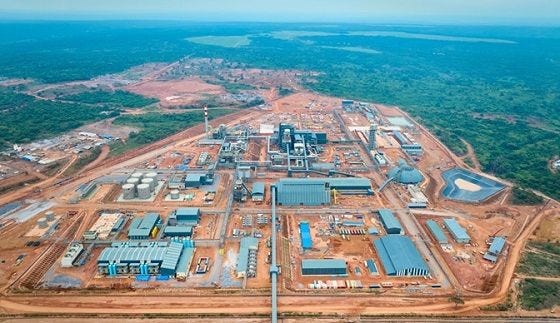
Africa's largest copper smelter, 500,000 tpa direct-to-blister, began heat-up in November 2025. First anodes: 29 December 2025. Kamoa-Kakula had previously sold copper as concentrate. The first anode sale was announced in February 2026; the shipment reached Lobito before quarter-end. In June 2026, Kamoa-Kakula copper anodes arrived at the Aurubis refinery in Olen, Belgium: Kamoa-Kakula's first DRC-smelted anode shipment to reach a European refinery via the Lobito Corridor. It runs predominantly on hydroelectricity. Ivanhoe reported 2022 Scope 1 and 2 emissions of 0.16 tCO₂ per tonne of copper: among the lowest reported by any major copper mine.
From small crosses to cathode, from Lualaba sand to Belgian refinery: the Lualaba basin has been working copper for seventeen centuries.
Twenty-two years after Ivanplats flew its first survey over this ground, that copper reached a European refinery as anode.