


Originally published on LinkedIn on 29 September 2026. This work is AI-assisted - read about how I work.
North Mara’s Gokona underground runs at about 5 g/t gold. Bulyanhulu’s narrow reefs average about 6 g/t, higher still at depth. The potential was never the problem.
In 2017, Tanzania banned concentrate exports and presented Acacia Mining with a US$190 billion tax bill, roughly four times the country’s GDP. Acacia’s market value collapsed. North Mara kept producing, but Bulyanhulu’s underground operations stopped. The ore had not failed. The relationship around it had.
Sukuma miners had worked numerous pits at Bulyanhulu. Tanzania’s High Court issued a temporary injunction restraining their eviction while the underlying case was pending. Tanzanian police and Kahama Mining Corporation, Sutton Resources’ local subsidiary, nevertheless carried out a forced eviction in August 1996. At North Mara, Kuria communities had also mined gold before Placer Dome arrived.
Barrick Mining Corporation acquired Bulyanhulu from Sutton in 1999 and North Mara through Placer Dome in 2006. It listed African Barrick Gold in London in 2010; the company became Acacia Mining in 2014. By 2017, the company at the centre of Tanzania’s confrontation with its mining industry was Acacia.
The Tanzanian government refused to deal with it. Barrick returned to the table.
In 2019 Barrick bought the 36.1% of Acacia it did not already own in a transaction valued at about US$1.2 billion, agreed a US$300 million settlement and formed Twiga Minerals: 84% Barrick, 16% Tanzania, with economic benefits shared equally after the recoupment of capital investment.
But an agreement did not restart Bulyanhulu. People and machinery did.
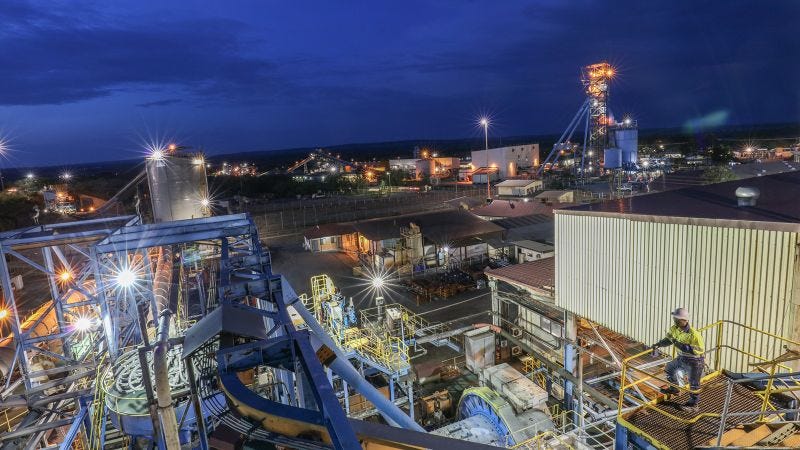
Twiga rebuilt the shafts, winders and plant. More than 600 workers joined from January 2020; underground ore returned that year. In October 2021, MSALABS commissioned Africa’s first Chrysos PhotonAssay laboratory at Bulyanhulu. At North Mara, extensions to the Gokona underground and Gena open pit drove reserve growth in 2024.
Together, the mines first produced more than 500,000 oz in 2021. Barrick now describes them as a combined Tier One complex. In 2024 they spent US$573 million with Tanzanian suppliers, 83% of total in-country procurement. Of Twiga’s 6,185 workers, 96% were Tanzanian and 53% came from nearby communities.
Human Rights Watch reported six deaths in 2024 linked to Tanzanian police at and around North Mara. Barrick says its own guards are unarmed, the mine holds no weapons, and police remain under state command. MiningWatch nevertheless calls them “mine police”.
Bulyanhulu’s growth case now reaches into Deep West, where drilling has encountered high grades at depth. The deposits did not change. Government intervention stopped one mine; Barrick rebuilt the operating capability, and Twiga restored the agreement that allowed both to work.