


Originally published on LinkedIn on 28 September 2026. This work is AI-assisted - read about how I work.
Tanzania enacted three principal mining statutes in 31 years: 1979, 1998 and 2010. Yet its greatest break came in 2017, without repealing the 2010 Act.
The pattern is an escalating transfer of control from the negotiating table into statute.
The 1979 Act placed the minerals under state ownership. The 1998 Act opened the industry to private, largely foreign capital through development agreements. The 2010 Act tightened that settlement after Tanzania concluded that mining was returning too little revenue and too little benefit to its people.
Then a dispute over mineral concentrates exposed a deeper problem: the state believed it could neither verify the value leaving the country nor capture its proper share.
I have spent my working life around mining law, but Tanzania's statute book is not my jurisdiction. This is a story drawn from the public record, not legal advice.
In 2017 Tanzania did not replace its Mining Act. It rewrote what the Act was for.
Development agreements gave way to a compulsory state position. Government must hold at least a 16% non-dilutable free-carried interest in every mining operation, with power to acquire up to 50% to reflect tax expenditure granted to a company.
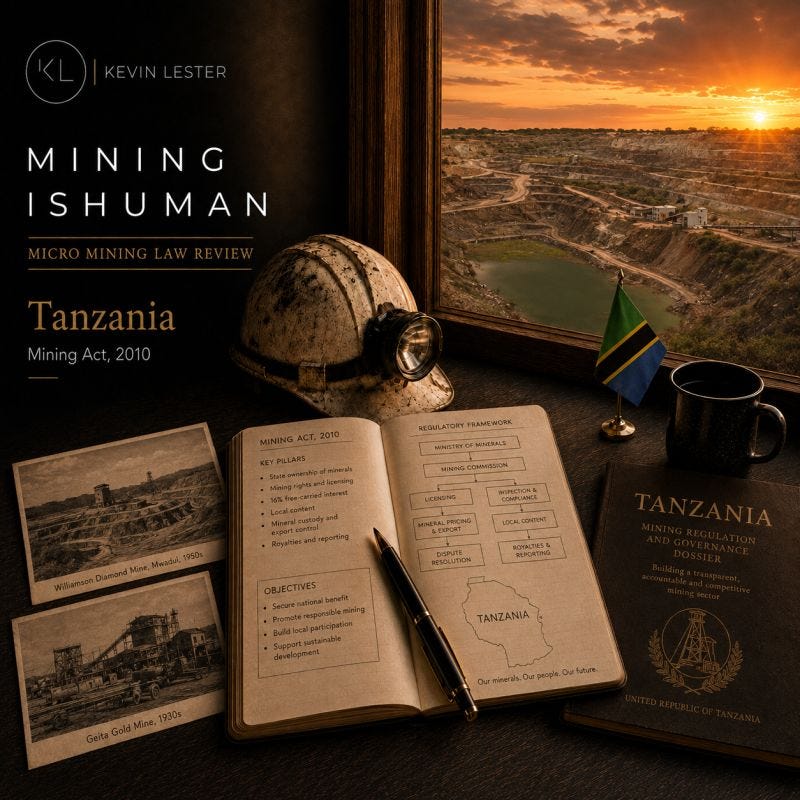
The new Mining Commission replaced the Mining Advisory Board and absorbed the Tanzania Minerals Audit Agency's functions. It received licensing, inspection, pricing and dispute-resolution powers. The Act also strengthened state control over the mineral itself through a government lien and mandatory supervised storage.
The settlement joined ownership, regulation and physical custody. Its ambition was equally direct: mining should contribute 10% of GDP. Government reported that the sector reached 10.1% in 2024.
The friction arrived before the machinery had settled.
After Tanzania banned concentrate exports in March 2017, officials detained 277 Acacia Mining containers. The government later assessed Acacia for an alleged US$190bn in tax, interest and penalties. The figure was never finally adjudicated.
Instead, Barrick Mining Corporation, Acacia’s majority shareholder, negotiated. The eventual settlement gave Tanzania a 16% interest in the mines, US$300m and a 50:50 share of economic benefits through Twiga Minerals Corporation. Concentrate exports resumed in 2020 after Barrick paid the first tranche.
That bargain helped make the new statutory settlement real. It also exposed its tension. A system built to remove mineral value from bilateral negotiation depended on a bilateral negotiation with the incumbent Tanzania could least afford to lose.
The 2010 Act still stands, amended repeatedly through 2025. Tanzania has not abandoned its pattern of moving control into statute. The durability test is whether that statutory settlement can withstand the next major investor dispute without requiring another exception outside it.