


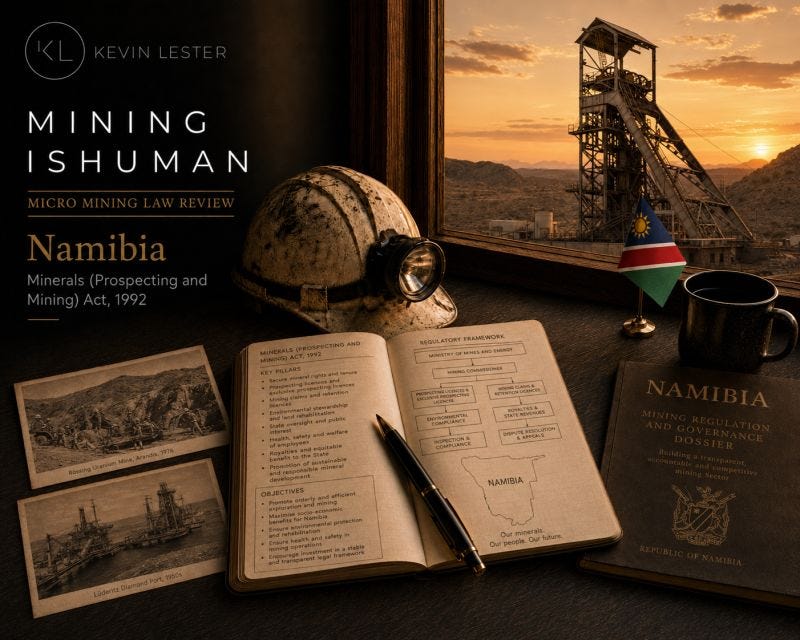
Originally published on LinkedIn on 14 September 2026. This work is AI-assisted - read about how I work.
Namibia became independent in 1990. Two years later, it enacted the Minerals (Prospecting and Mining) Act 33 of 1992, commencing on 1 April 1994 — its first post-independence principal mining statute, replacing the Mines, Works and Minerals Ordinance 20 of 1968, a colonial South West African ordinance.
More than three decades later, Namibia has not replaced it.
The pattern is continuity: one post-independence mining settlement, adjusted fiscally but never replaced.
I work around mining law. Namibia's statute book is not my jurisdiction. What follows is a reading of the public record.
The Act's foundational move is Section 2: rights over minerals vest in the State, regardless of who owns the surface land. That principle remains. The only amendment recorded in NamibLII's current consolidation, Act 8 of 2008, left it untouched. It authorised certain royalties, including a windfall royalty, and removed maximum-rate restrictions: fiscal recalibration within the existing architecture, not a replacement of it.
Today, administration sits within the Ministry of Industries, Mines and Energy. Under the Act, the Minister appoints a Mining Commissioner, who acts subject to ministerial direction and control.
The Minerals Board of Namibia, established under Section 9, is advisory, with Chamber of Mines nominees, small-scale prospecting and mining representatives, a trade-union representative and ministry officials. The Minerals Ancillary Rights Commission, established under Section 108, considers applications for ancillary rights.
Three provisions carry the regime's direction.
Section 2 vests the mineral estate in the State. Section 3 requires a licence before prospecting or mining begins and written ministerial approval before any licence is transferred. Section 7 bars the Mining Commissioner and specified officers from holding direct or indirect interests in licences or the companies that hold them.
That discretion reaches commodity scope: the Minister may declare any mineral other than a diamond 'controlled' or 'high value' by Gazette notice, changing its regulatory profile without rewriting the Act.
The Act contains no general regulation-making clause. Instead, specific Gazette-notice powers govern fees (Section 123), exemptions (Section 137), mineral classification (Section 1) and land reservation (Section 122). A 2021 fee schedule gazetted under Section 123(1), repealing its 1994 predecessor, shows the machinery still working.
Independent Namibia's first mining statute has now governed for almost the full life of the country itself.
Longevity is established. The more interesting question is whether the design the 1992 Act established can still carry what it is now asked to govern.