


Originally published on LinkedIn on 3 September 2026. This work is AI-assisted - read about how I work.
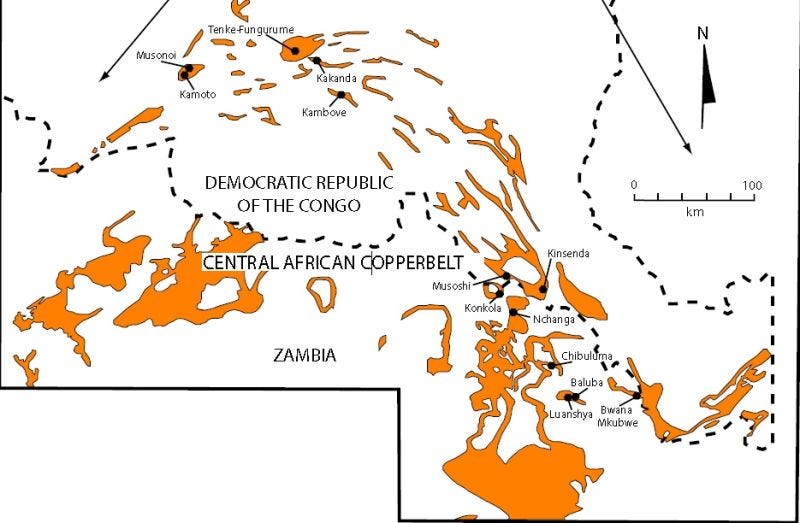
One folded basin beneath Zambia and the Congo holds about half the world's known sediment-hosted copper. It is the largest thing in this story and the least representative. The other five got their copper by other means, and mostly not the same means twice.
I am a lawyer reading other people's fieldwork. This is what I think it says.
About 880 million years ago the Congo and Kalahari cratons began to pull apart. The rift between them filled with salt flats, red sand and black mud rich in organic matter. That became the Roan Group, where almost all the copper sits. About 30% of it has been taken. The rest is still in the ground.
Copper does not move through the Earth as metal. It moves dissolved in hot, salty water that strips it from older rock until the chemistry changes. Where oxygen-rich water met black organic mud, the copper dropped out as sulphide. The boundary between the red rock and the black rock became the deposit. Then it happened again. Between 590 and 512 million years ago the cratons collided and closed the basin, driving the fluids through the rocks again.
The result is long, flat ore layers rather than veins. At Nkana the high-grade ore runs for about 16 km. Ore laid out like that needs a railway and earns one. The railway reached Lubumbashi in 1910.
The Congolese side of the basin is dolomitic and rich in cobalt. The Zambian side is sandier and poorer in it.
The same chemistry appears again across Botswana into Namibia, in younger rock and with silver replacing much of the cobalt. That belt runs 1,000 km beneath 10 to 100 m of Kalahari sand, which is why it was found last, not why it is small.
Okiep is copper that came out of molten rock. Around 1.03 billion years ago magma forced its way into the crust in small bodies. As it cooled, copper sulphide separated out. About 1,700 of those bodies lie across 2,500 km², less than 1% of the surface. They produced 2 Mt of copper between 1852 and 2002.
Prieska is copper that came out of the sea floor. Hot fluid vented into ancient water and left a lens of metal on the bottom, later folded and cooked by the collision that built Namaqualand. It produced 430,000 t of copper between 1971 and 1991.
Palabora is copper that rode up inside mantle-derived magma. About 2.06 billion years ago it rose through the old crust in three pulses, and the copper came with the last.
Tsumeb was a copper mine. So was Messina. Each got there by a route of its own, and neither was any of these.
Nkana's ore runs for 16 km in a single layer and helped build a railway and four generations of a town. Okiep's copper lay scattered through 1,700 separate intrusions and sustained thirty-two mines over 150 years.
We call both copper mines. The copper is almost the only thing they have in common.