

Originally published on LinkedIn. This work is AI-assisted - read about how I work.
In 1998, Barrick Mining Corporation and AngloGold Ashanti drilled the Karagba-Chaffeur-Durba deposit in Congo and confirmed a world-class orebody. Then civil war forced them out.
The deposit waited eleven years.
The ground they left is in Haut-Uélé Province, a goldfield where artisanal mining families have worked alluvial gold for generations. Colonial prospectors documented the discovery in 1903. The colonial state extracted an estimated 300 tonnes before Congolese independence in 1960. Much of the labour was compelled.
After independence, state mining company SOKIMO held the concession. Moto Goldmines, a Canadian explorer, acquired 70% of the KCD licence in 2004 and grew from C$0.04 to C$4.00.
In 2009, Randgold Resources and AGA acquired Moto Goldmines for US$502m and took the deposit 45/45, with SOKIMO retaining 10%. That December, one of Central Africa’s most brutal armed groups killed at least 321 civilians in Haut-Uélé.
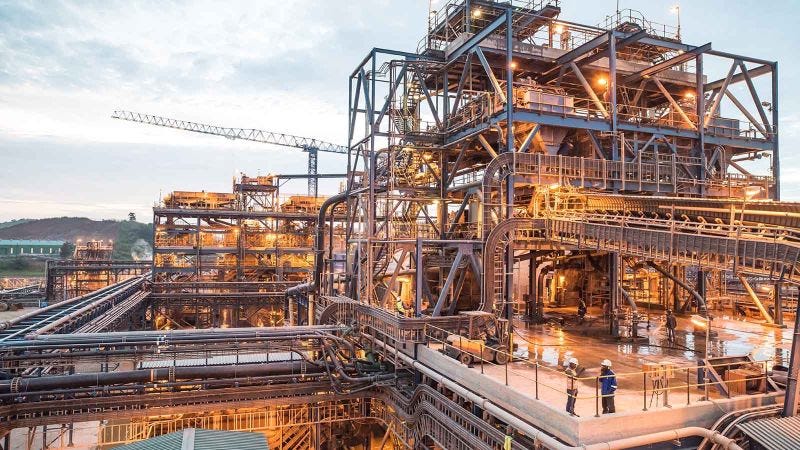
Construction nevertheless began in 2012. At peak, 400 containers crossed the Ugandan border each week after travelling 1,800 km from Mombasa. With no grid reaching Haut-Uélé, Randgold built its own run-of-river hydropower system. First gold poured in November 2013.
Resettlement remains contested. In 2021, DRC security forces demolished more than 2,500 houses in the area, with deaths reported during the unrest. OECD complaints followed: Canada’s process against Barrick closed without resolution; AGA’s UK complaint continues. The operators reject allegations of involvement.
Today, Kibali employs 6,500 people, 95% of them Congolese nationals. More than US$6.3bn has been invested in-country, including US$3.1bn with local contractors and partners, while more than 700 Congolese companies participate in procurement programmes. Three hydropower stations, supplemented by solar and battery storage, supplied 85% renewable electricity in 2025.
The geology has proved equally remarkable. Since first gold, Kibali has added more reserves than it has depleted through mining. Drilling continues to extend KCD, while the emerging ARK target, 4km from the plant, has the potential to become another multi-million-ounce orebody. Mine life extends to 2043.
Kibali also has an ownership structure more familiar in giant copper mines than in gold: no majority owner. When Randgold merged with Barrick in 2018, Barrick inherited its 45%. AGA still holds 45% and SOKIMO 10%.
The two companies forced from KCD by war in 1998 had, by a very different route, become partners in developing it.
In 2025, Kibali produced 673 koz. Barrick reported US$2.3bn in revenue and an M&I resource of 18 Moz, both on a 100% basis.
Twenty-eight years after war drove Barrick and AngloGold from KCD, they are still finding more gold around the deposit they discovered.