


Originally published on LinkedIn. This work is AI-assisted - read about how I work.
Zambia's Fifth Mining Law in Fifty Years (Mining Is Human, Story 62)
Zambia has rewritten its principal mining law roughly once a decade since 1972. Each rewrite reflects the mining challenge of its time.
In 1995, the priority was privatisation. In 2008, it was unwinding the Development Agreements privatisation had produced. In 2015, it was restoring stability after years of fiscal and licensing volatility.
Beneath the rewrites lies a consistent pattern: incremental institutional reform, with a persistent commitment to widening the societal benefit of mining.
The fifth rewrite advances that pattern while addressing a different challenge.
I spent my working life around mining law, but Zambia’s statute book was not my jurisdiction. Here is what I noticed from the public record.
Zambia wants 3Mt of copper annually by 2031, up from roughly 800,000t. Ambition on that scale requires something less glamorous, but no less important, than another mine: a regulatory system capable of administering it.
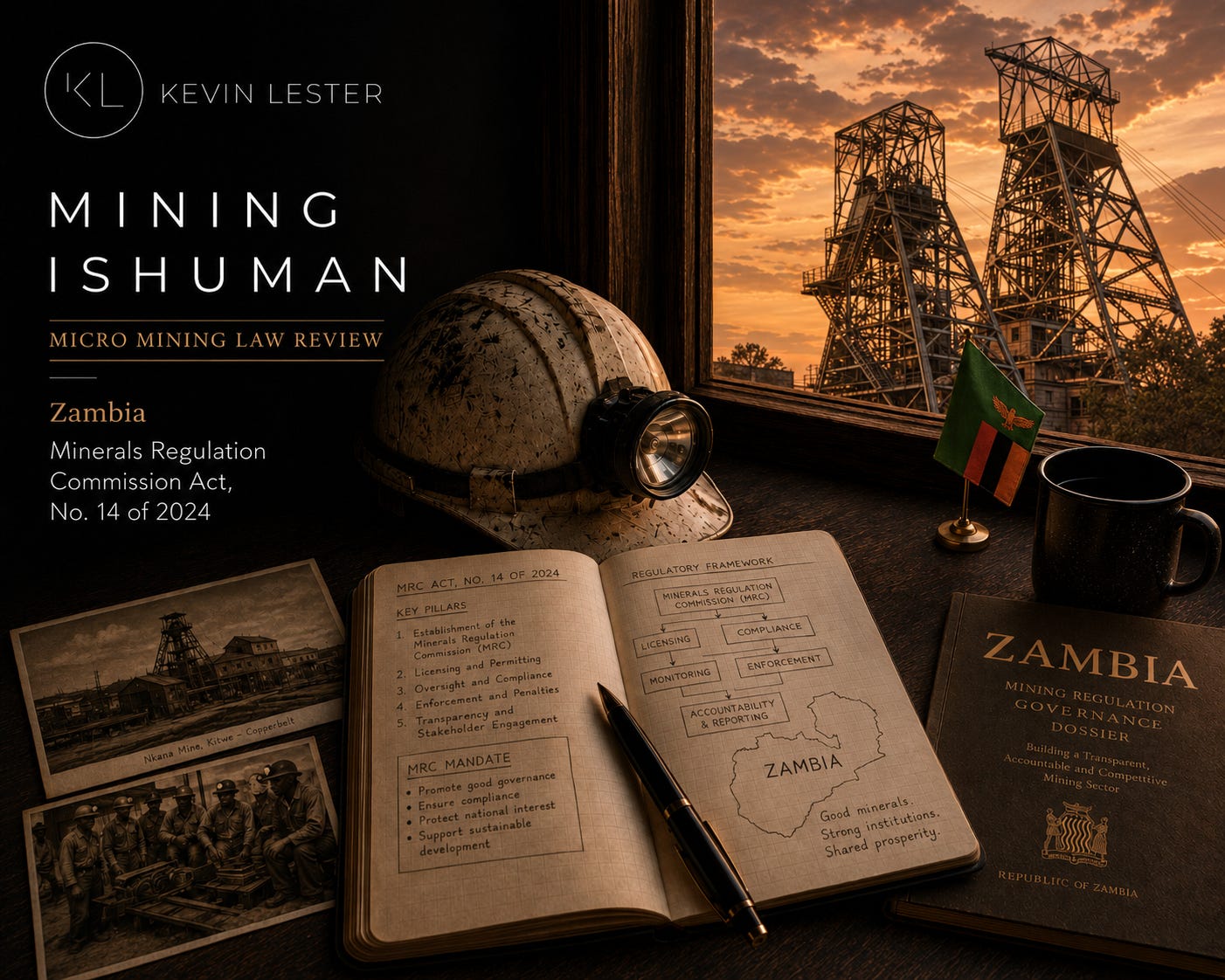
That, I think, is the opportunity the Minerals Regulation Commission Act, No. 14 of 2024 is designed to seize.
Much of the law is familiar. The Tribunal, royalty structure, environmental fund and citizen-empowerment orientation existed under the 2015 Act—continuities refined rather than invented.
The new element is institutional. The MRCA replaces fragmented ministerial directorates with an independent Commission empowered to grant, suspend and revoke rights, monitor operations and rehabilitation budgets, and advise on policy.
Three provisions reveal the settlement being pursued.
Section 65 extends liability for environmental harm beyond the licence holder to any person who directly contributed to the act or omission causing it. Corporate responsibility no longer necessarily ends with the corporation.
Section 87 caps mining rights at five per person or entity, subject to compliance and demonstrated financial capacity. While seeking to triple copper output, Zambia is also limiting concentration of the rights required to produce it.
SI No. 68 of 2025 reserves 20% of core-mining procurement for local companies in 2026, rising to 40% within five years. Non-core services, including catering, security and haulage, are reserved for Zambian companies.
On paper, the design is coherent. The opportunity now is to translate that design into institutional capacity.
The Tribunal existed under the 2015 Act but was never constituted. Under the new regime it was sworn in only in June 2026. The World Bank documented outstanding implementing regulations, a Commission not fully operational, a digital cadastre suspended after launch, and substantial licensing delays.
The promise of the MRCA is not only whether Zambia has designed a better mining law.
It lies in whether its institutions become durable enough to make the fifth rewrite the foundation for Zambia’s next era of mining, rather than leave a sixth to solve its unfinished business.