


Originally published on LinkedIn. This work is AI-assisted - read about how I work.
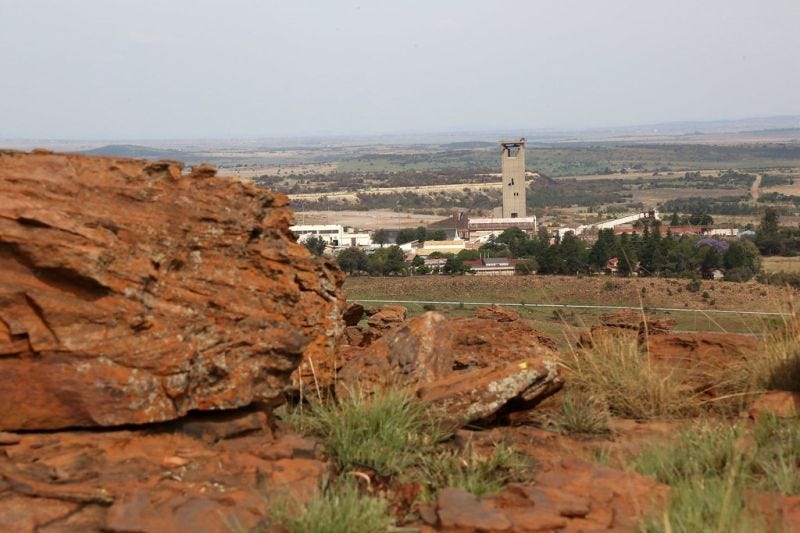
Magnetometric surveys traced the buried West Wits Line in the 1930s. The reef did not show at surface. It turned out to be the richest gold corridor ever worked. South Deep, featured earlier in this series, lies alongside it on the same reef system.
One mine on it, Driefontein, poured a hundred million ounces of gold. No other mine in history has reached that figure. Kloof, beside it on the West Wits Line, also works the Ventersdorp Contact Reef. It has been given one more year. The gold price will decide the next one.
The ground was Kwena country first. From 1827 to 1836, Maselwane’s community lived in the Lepalong caves on Kleinfontein farm, sheltering from Mzilikazi’s expansion. People lived beneath the same ground that would later be mined from below.
Capital arrived by instrument, not outcrop. GOLD FIELDS backed magnetometry to trace the buried formations and pressure cementation to sink through water-bearing dolomite. It invented neither. Its contribution was to recognise what both made possible, combine them and commit capital when much of the industry would not. West Driefontein milled its first ore in 1952. Gold was first mined on what is now Kloof in 1934.
On 30 August 2005, after fifty-three years, Driefontein poured its hundred millionth ounce. Its lifetime grade averaged 14.2 g/t. By then it employed about 16,800 people.
The ground that gave also took. Men died in a sinkhole in 1962. A vast water inrush nearly took the mine in 1968. It was rebuilt and kept running. Khutsong, built beside the mines and sustained by their labour economy, grew on that gold. Its economy now thins as the mines do.
Gold Fields’ lineage shaped the district for decades. In 2013 it unbundled its mature South African mines into Sibanye Gold. Sibanye-Stillwater runs both today. DRDGOLD Limited, now majority Sibanye-owned, reprocesses West Rand tailings at one of the world’s largest gold surface-retreatment operations.
Sibanye’s 2025 year-end plan runs Driefontein to 2036. Kloof has one year at a time. Driefontein reaches beyond 3,000m; Kloof is also ultra-deep. The rock runs hot and every ounce carries the cost of reaching it. The CEO told the market in February 2026 that Kloof has no long-life reserves and will run while it makes sense.
Its H2 2025 cost was about US$4,080/oz, against spot gold near US$4,340/oz. A court has ordered Eskom to grant the wayleave sought for a solar plant. As elsewhere across the region, electricity prices bear directly on jobs and whether mines can continue to operate. Gold and electricity prices are now central to Kloof’s year-by-year economics.
The West Wits reef system that made Driefontein continues beneath Kloof. Its future now lies in what can still be mined underground, what cheaper power can preserve, and what can be recovered from the tailings.