


Originally published on LinkedIn. This work is AI-assisted - read about how I work.
Newly independent Zambia wanted to reset the economics of mining. Kenneth Kaunda did what many nations have done. He did it with one distinction: he paid.
The Mulungushi reforms of 1968 had already nationalised Zambia’s major industries. A year later the Matero Declaration placed 51% of the Copperbelt’s mines into state hands.
By 1969, the same two houses that had dominated the Copperbelt since the 1930s had restructured, absorbing several of their founding investors into new corporate forms. American Metal Company had become AMAX in 1957. The British South Africa Company had gone into Charter Consolidated in 1965. AMAX held 43% of Roan Selection Trust. Anglo held minority interests in RST’s subsidiaries, and 12.25% of Roan Consolidated Mines.
Compensation was to be settled in bonds redeemable over a decade. In 1973 the government redeemed them early and ended the management contracts under which both still ran their former mines. Both left with money in hand.
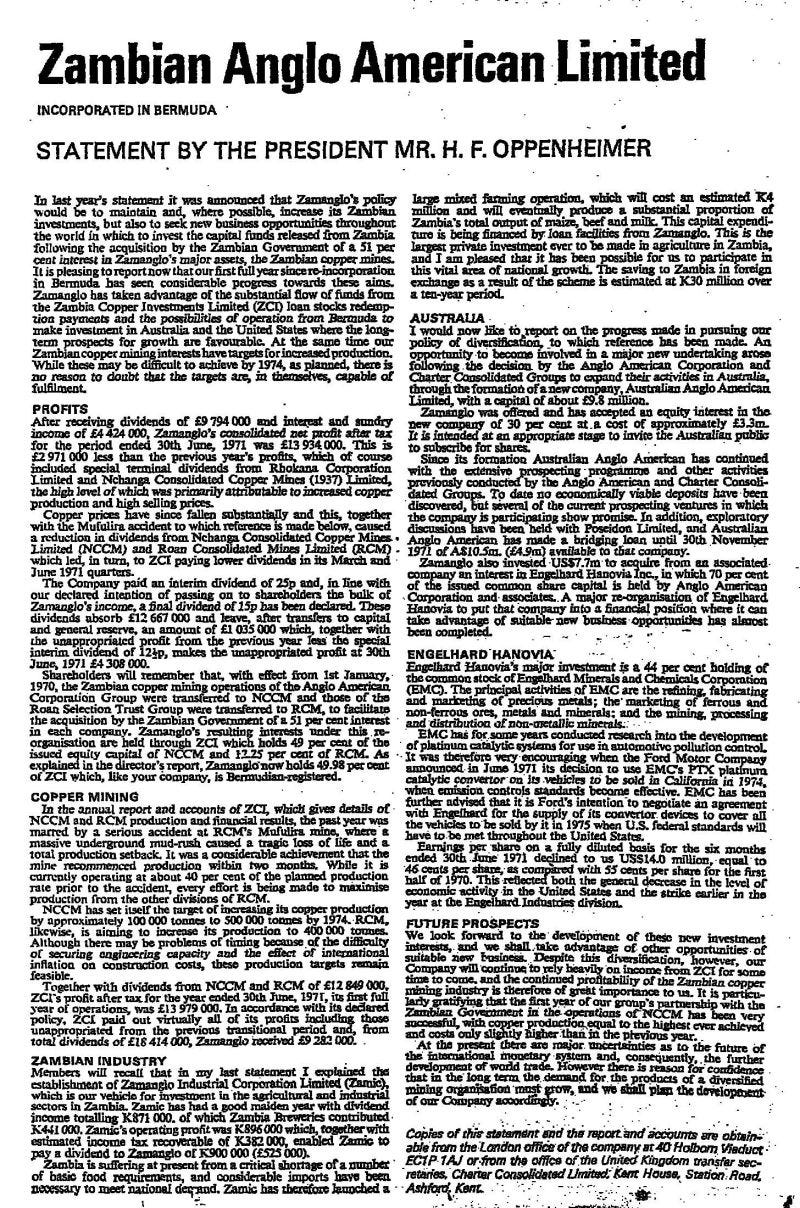
Anglo’s own vehicle was Zambian Anglo American. In a statement by that company to shareholders published on 16 September 1971, H.F. Oppenheimer set out the policy: capital released from Zambia by the 51% acquisition would go to Australia and the USA. In Australia, the capital formed Australian Anglo American with about £9.8m. In the USA, investments had already been made into Engelhard.
Zambian Anglo American was redomiciled to Bermuda and renamed Minorco. That company and Anglo American would merge their interests in 1999 to form Anglo American plc.
Roan Selection Trust ran a different route. Selection Trust, the British holding company, passed to BP in 1980, then to Rio Tinto in 1989. The AMAX lineage ran to Cyprus AMAX, Phelps Dodge, then Freeport-McMoRan. Zero presence in Zambia.
Eunomix Research put Zambia’s lost mining rents between 1970 and 2010 at about US$45bn. That is what the rupture cost. Production fell from a peak of about 770kt in 1969 to 250kt in 2000. The world did not stop needing copper.
Anglo’s mines at Nchanga and Konkola passed through privatisation into KCM, now held by Vedanta Group.
Nkana, Anglo’s other great Copperbelt mine, was combined with RST’s Mufulira to form Mopani Copper Mines Plc, now 51% owned by International Resources Holding of Abu Dhabi. RST’s remaining Zambian mines passed to CNMC at Luanshya and CNMC/NFC Africa Mining at Chambishi.
Zambia produced close to 900kt in 2025. The government targets 3Mt by 2031. That ambition is the measure of both the depth of the decline and the scale of the recovery. The rebuilding is now being led by Barrick Mining Corporation, First Quantum Minerals, Vedanta Group and IRH.
What’s missing from that arithmetic isn’t corporate. It’s a generation of Zambians who grew up on the far side of what the copper could have built.
1969 was the lesson. 2031 is the exam.