


Originally published on LinkedIn. This work is AI-assisted - read about how I work.
My friends know I am a genealogy enthusiast. Today’s story is the wrong kind of genealogy: it traces extinction, not descent.
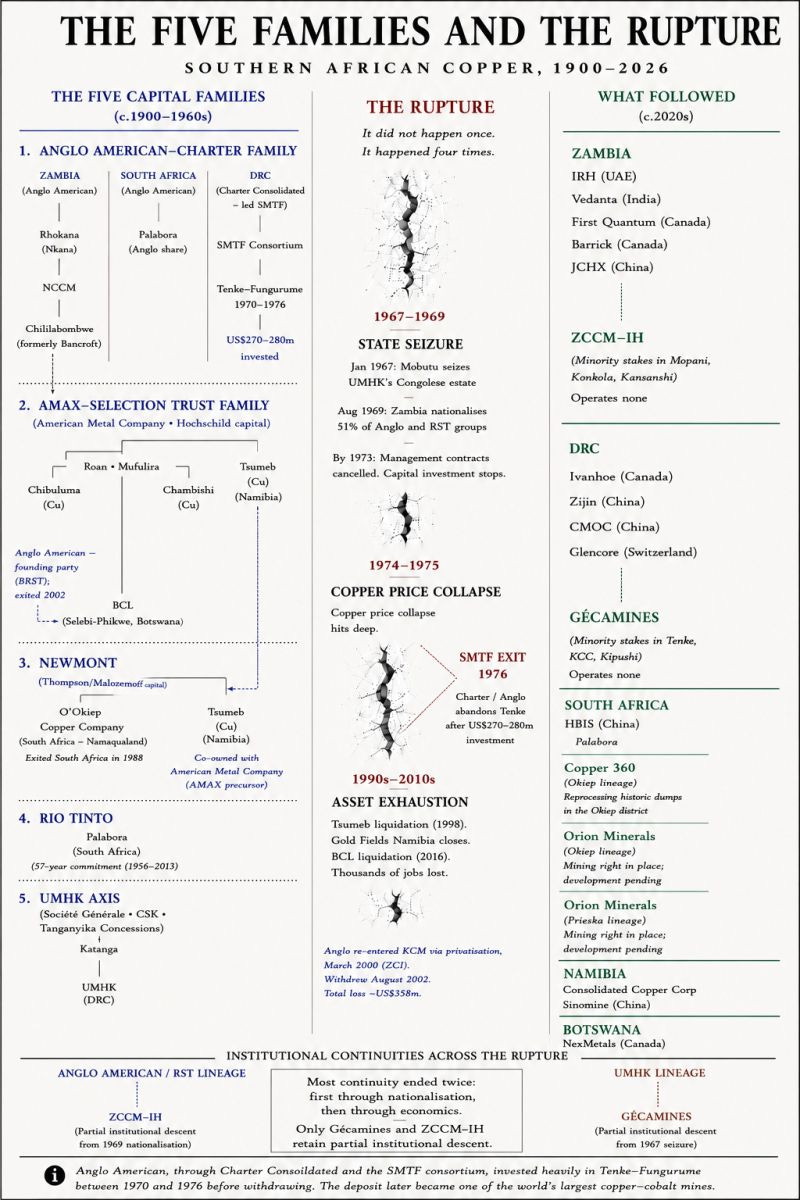
Five capital families built the flagship copper mines across southern Africa between 1900 and the 1960s. Anglo American. AMAX and Selection Trust. Newmont Corporation. Rio Tinto. And Union Minière du Haut-Katanga.
Anglo ran Zambia’s Copperbelt through Rhokana, Nchanga, and Bancroft. Its Katanga exposure ran indirectly, through Tanganyika Concessions and a board seat at UMHK.
AMAX and Selection Trust ran the RST mines in Zambia and BCL in Botswana. BCL was not solely an AMAX asset. Anglo was a founding party alongside RST, held through its subsidiary BRST. When AMAX exited in 1993, Anglo remained the dominant private partner. Selebi-Phikwe was an extension of the same Copperbelt capital that built Zambia.
Newmont held Okiep in the Northern Cape. At Tsumeb in Namibia, the two American houses met each other.
Rio Tinto ran Palabora for 57 years. Anglo held 16.8% alongside it.
UMHK built a copper state within a state in Katanga, producing around 300,000t a year by 1960.
Then the rupture.
It did not happen once. It happened four times.
January 1967: Mobutu seized UMHK’s Congolese estate. The break was total. August 1969: Zambia nationalised 51% of both the Anglo and RST groups. Management contracts were cancelled by 1973.
Commercial exits followed by different means. Tsumeb reached 1,700m, entered a price collapse, and went into liquidation in 1998.
BCL was placed into liquidation in 2016. More than four thousand workers were made redundant on a single day.
Not one of the five families, nor a descendant, holds a copper asset on the ground in southern Africa today.
Two institutional threads survived the rupture: the post-nationalisation state-owned entities to which the original assets were granted. In Zambia, the Anglo and RST mines passed to ZCCM Investments Holdings Plc, which now holds minority stakes in Mopani, Konkola, and Kansanshi. It operates none of them.
In the DRC, UMHK’s seized assets were granted to Gecamines S.A., which holds minority positions in Tenke Fungurume and KCC. It operates none of them either.
Anglo’s copper is now in Chile, Peru, and the Americas. AMAX fed to Freeport-McMoRan via Phelps Dodge; Selection Trust fed to Rio Tinto via BP Minerals. Neither in southern Africa.
The new holders inherited the ground: International Resources Holding at Mopani, Vedanta Group at Konkola, Ivanhoe Mines and Zijin Mining Group at Kamoa-Kakula, CMOC at Tenke Fungurume. Extraordinary ore bodies. They did not inherit the institutions or the decades between.
The years the rupture cost are not recoverable.
hashtag#MiningIsHuman hashtag#Copper
Though not a capital family like the others in the story, Anglovaal built Prieska in 1971 and closed it 20 years later in 1991. It is now being developed by Orion Minerals Ltd.