

Originally published on LinkedIn on 23 April 2026. This work is AI-assisted - read about how I work.
The ore runs out. What gets left behind does not always. This is a story about the gap between the two.
The Haiǁom, a San people of the Otavi Mountains, mined copper here long before any European arrived. The first shaft at Otavi was sunk at a pit the Haiǁom had already dug.
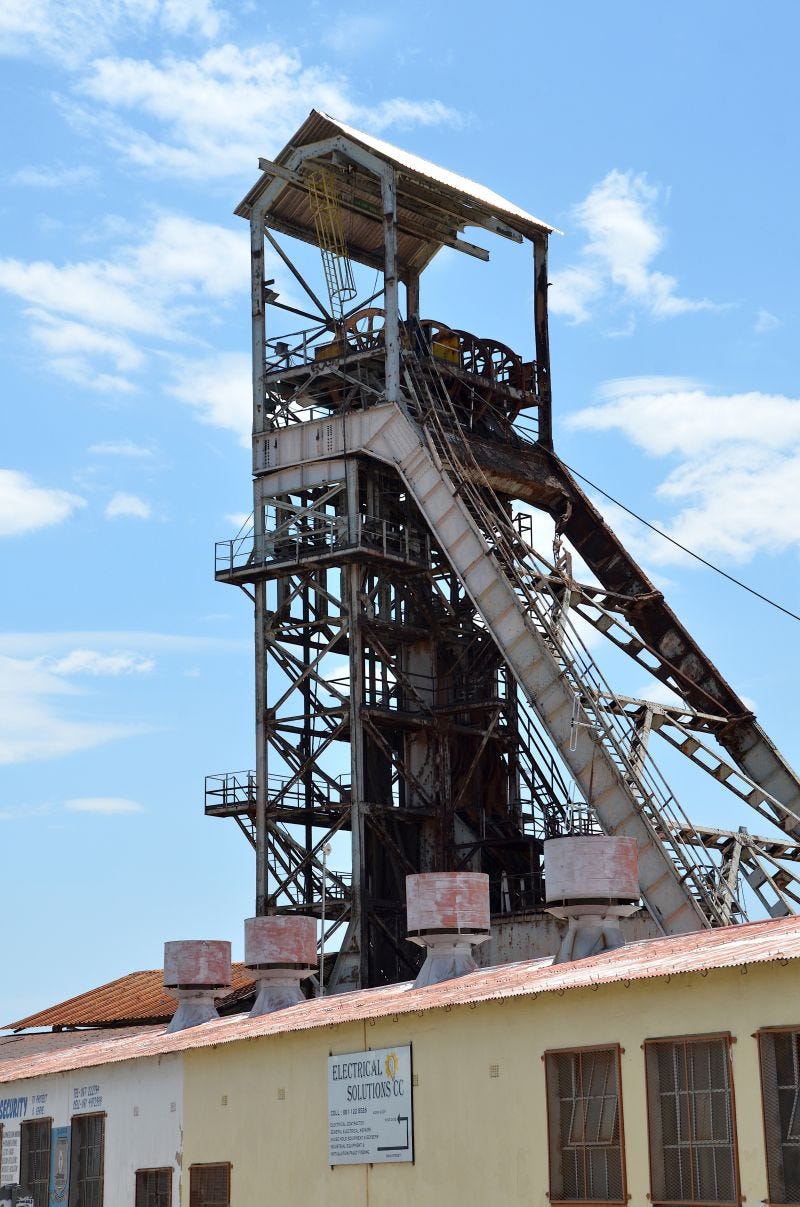
Namibia’s Tsumeb mine opened around 1900 and ran for nearly a century. Thirty million tonnes of ore. Over 337 distinct mineral species — 72 found nowhere else on earth. At its peak, Tsumeb Corporation Limited (TCL) employed 6,200 workers, Namibia’s largest private employer.
TCL was not a standalone venture. In 1947, Newmont Mining and American Metal Company (later AMAX) acquired the mine, together controlling approximately 65% of TCL in a mine whose polymetallic complexity made it unlike anything either company had operated before. AMAX sold in 1982; Newmont followed.
The ore held copper, lead, zinc and silver. It also contained germanium and gallium, which were not recovered. The world had not yet invented a reason to want them.
The mine closed in 1996 when the deepest workings reached 1,700 metres and became uneconomic. Low prices and a strike ended them permanently. TCL entered liquidation in April 1998. Most businesses in town closed. The hospital closed. The town contracted and waited.
The smelter survived, reinventing under subsequent owners, some of whom processed arsenic-rich concentrates. In 2024, the Sinomine Resource Group acquired the smelter and processing operations for US$20 million. An arsenic legacy remains above the town, a legacy the project will have to mitigate.
Sinomine’s filing with the Shenzhen Stock Exchange disclosed the slag inventory: 746 tonnes of germanium and 410 tonnes of gallium. Global annual germanium production is 243 tonnes. The slag holds three years of world supply.
In July 2023, China announced export controls on germanium and gallium, effective from August. Prices surged. Western governments declared both metals critical.
The largest non-Asian germanium slag deposit is now owned by a Chinese company — the same country restricting its export. That is the paradox Tsumeb inhabits.
Sinomine announced in April 2025 a N$2 billion Multi-Metals Recycling project. 200,000 tonnes of slag annually over a projected 15-to-20-year operating life.
A town written off now has two decades of work waiting in its slag heap.
Mining is always human.
This is ground that surprised.