


Originally published on LinkedIn. This work is AI-assisted - read about how I work.
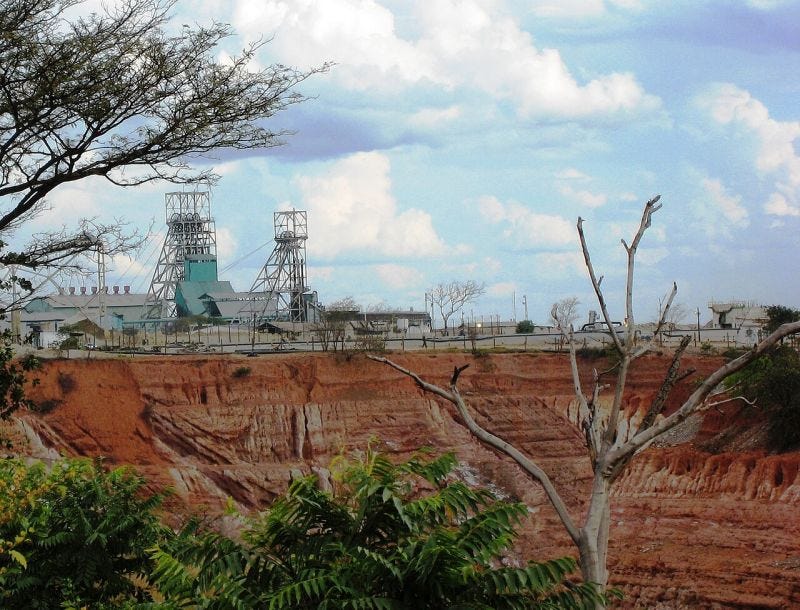
Two mines, one company, and neither has finished finding out how deep the ore runs.
The Lamba people had a name for this ground before any of them: Ilamba. Lambaland. They smelted its copper and traded it along routes reaching the Indian Ocean long before any company registered title to it. A Portuguese explorer documented them doing so in 1798. A British scout found them wearing copper bracelets along the Kafue River in 1895, marked the deposit, and moved on. What he filed as a discovery was what the Lamba already knew. Anglo American arrived thirty-three years later.
Anglo American did not come to Nkana for the scenery. The ore graded approximately 2.5 times the contemporary US benchmark. Rhokana Corporation sank the first shafts in 1928, backed by capital from South Africa, Britain, and the United States. On 17 March 1932, the smelter produced its first blister copper.
From first production to 1969, Rhokana Corporation held the mine for thirty-seven years, the largest employer on the Copperbelt. The Matero Declaration brought the Zambian government to 51%. Rhokana was absorbed into state ownership and, by 1982, into Zambia Consolidated Copper Mines. The mine had its second name: Nkana, under ZCCM.
The ore body had not moved.
On 1 April 2000, Glencore, through its Carlisa vehicle, and First Quantum Minerals acquired the Nkana and Mufulira assets from ZCCM. Mopani Copper Mines Plc became the name above the gate.
Ownership changed again. In January 2021, Glencore and First Quantum transferred their combined 90% stake to ZCCM Investments Holdings Plc for US$1, with US$1.5bn of debt assumed. Three years later, ZCCM-IH sold 51% to Delta Mining, a vehicle of UAE-based International Resources Holding, under a US$1.1bn investment commitment. ZCCM-IH retained 49%. A Golden Share remained with the government.
Nkana’s Synclinorium Shaft, at 1,280m, held the depth record for four years. Mufulira’s Henderson Shaft passed it in June 2020, reaching 1,580m. Mindola Deeps, raise-bored to 1,892m, is still being equipped toward its 2,020m target. In Glencore’s final quarter, monthly production averaged 3,412 tonnes.
Under ZCCM-IH from April 2021, it averaged 8,598 tonnes.
The same deposit carries cobalt, mined continuously since the Nkana Cobalt Plant opened in 1982. The energy transition has not changed the ore body. It has changed who wants it.
Zambia’s Ministry of Mines confirmed copper output up 40.27% year on year in 2025. IRH has committed more than US$1.1bn to the recovery and has stated a target of 300,000 tonnes a year by 2029. In June 2026, Mopani declined Zambia’s government-allocated copper concentrate export waiver for the third consecutive time. All output goes to domestic refining.
Two mines, one gate above them both. The concentrate stays in Zambia this time. The ore body has not changed. The decisions around it have.