


Originally published on LinkedIn. This work is AI-assisted - read about how I work.
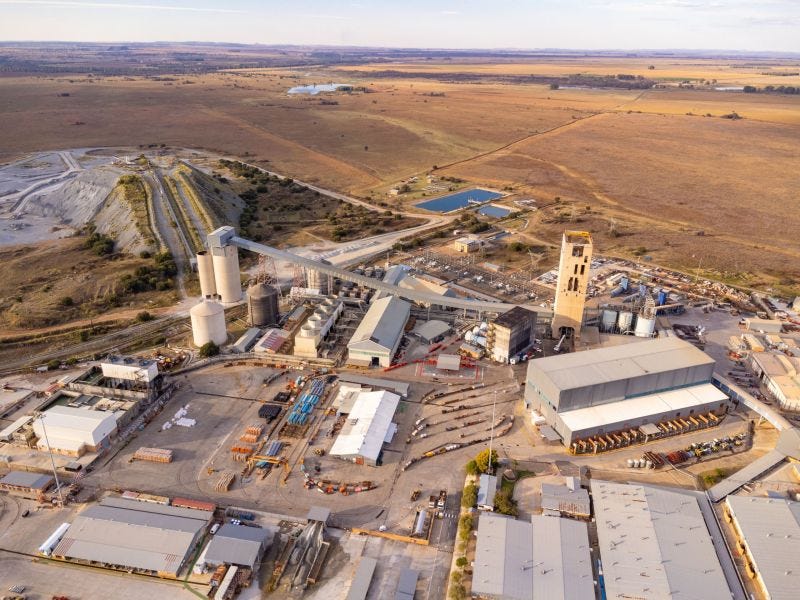
South of the Vaal River, 180 km from Johannesburg, a shaft drops 3 km into the earth. At the bottom sits the Vaal Reef, Neoarchean banket conglomerate laid down 2.7 billion years ago, carrying gold at 8.21 g/t recovered grade. That is roughly four times the global average for operating gold mines. The rock is ancient. The investment decision is current.
AngloGold Ashanti built this mine. Anglo American had worked Great Noligwa on the same ground since 1968, peaking at 483,000 oz a year before structural decline set in and the mine went on care and maintenance in 2015. At its height, the Vaal River complex was producing more than a million ounces a year. By the late 1990s, with Noligwa declining, the deeper ground was the answer. Moab Khotsong opened on a new-order mining right, sinking to 3,106 m. At construction, that was the world’s deepest single-lift shaft. It reached high-grade Vaal Reef below what the older workings could access. Stoping began in November 2003.
Tswana-speaking communities farmed and kept cattle along the Vaal here for centuries before the first colonial survey crossed this ground. Tswana remains the first language of Orkney, the town above the mine today.
As the gold price weakened after 2012, AngloGold Ashanti deferred Zaaiplaats, the planned life extension, citing competing capital priorities across its global portfolio. Four years later, in October 2017, it agreed to sell Moab Khotsong to Harmony Gold Mining Company Limited for US$300m. On those plans, the mine had about seven years of producing life left.
Today, 6,232 people work Moab Khotsong. The Tswana-speaking town was named Orkney by Simon Fraser, a Scots miner from the Orkney Isles, in the 1880s. The streets carry British literary names. In FY25, the mine was seismically active: heightened seismicity disrupted the middle mine; the top mine halted briefly for toxic gas removal. At 3 km below surface, seismic risk and gas management are part of every shift.
Harmony approved Zaaiplaats in 2021. Three declines are now sinking from 101 Level toward 103 Level, the critical-path milestone for production access, at 9 degrees, each 2,915 m long, no new shaft required. Zaaiplaats holds approximately 3.7 Moz of potential additional reserves at around 9 g/t.
Harmony spent R962m on the project in FY25 alone, with gold averaging US$2,622/oz that year. Moab Khotsong produced 198,820 oz in FY25. Production will dip over the next few years as the middle mine exhausts, with FY26 guided at 175,000–178,500 oz. It recovers to 225,000 oz a year at steady state.
The mine life, roughly seven years at acquisition, is now 19 years. The decline is sinking. Nineteen years of reef still to mine.
Orkney — British literary street names, Tswana first language, nothing like the islands it was named for — just secured nineteen more years of school fees and wages.