


Originally published on LinkedIn. This work is AI-assisted - read about how I work.
The Kalahari Manganese Field runs roughly 35km through the John Taolo Gaetsewe district of the Northern Cape. It holds more than 75% of the world's manganese. Two mines sit at its northern end, sharing the company town of Hotazel. One cuts from the surface. One goes 300 metres underground.
SA Manganese Ltd formed in 1926 to mine the Northern Cape deposits. In 1937, Dr H.J. van der Bijl, who founded both Eskom and Iscor, incorporated Amcor to process minerals into ferroalloys for South Africa's growing steel industry. Those two companies merged in 1975 to form Samancor Ltd, listed on the JSE.
By 1998, Samancor had become the world's largest ferroalloy producer, its reach extending from the Kalahari manganese fields to the ferrochrome smelters of the Steelpoort Valley. One company held both.
In 1998, Billiton (60%) and Anglo American (40%) bought out Samancor's minority shareholders and took it private. In 2005, BHP Billiton sold the chrome operations to the Kermas Group for US$469 million, separating the Steelpoort assets from the Kalahari ones. The manganese stayed. When BHP Billiton demerged South32 in May 2015, seeking a simpler portfolio focused on its Tier 1 assets, the Kalahari mines transferred with it. Anglo American retained 40%.
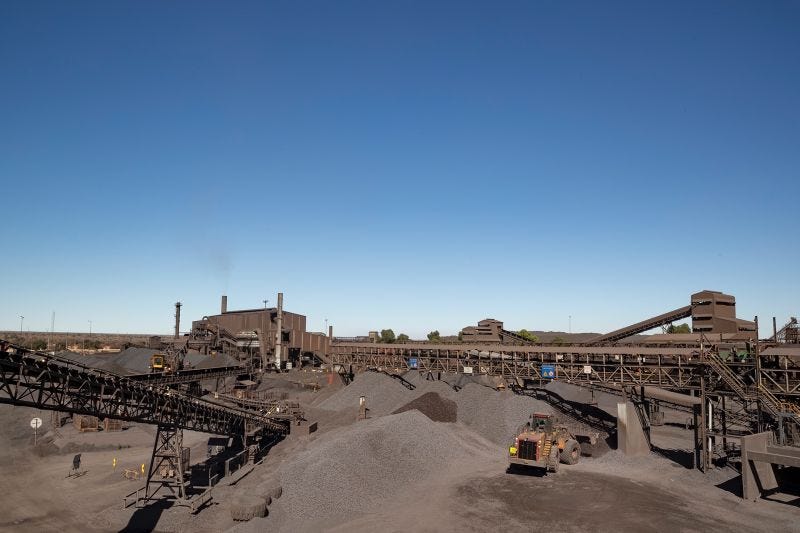
Mamatwan commenced operations in 1963. Terrace mining benches cut into primary carbonate ore at surface, currently producing approximately 2.91 million tonnes per annum, with around 15 years of mine life remaining. Dense medium separation and sintering upgrade the ore before export through Saldanha. In August 2025, HMM signed a 10-year export agreement with Transnet.
Wessels is different in every sense. The ore lies 300 metres down, reached through a vertical shaft and two inclines, recovered by mechanised bord-and-pillar mining. What it yields carries its own geological term: Wessels-type ore, the name given to the hydrothermally upgraded high-grade manganese found across the northern Kalahari. Grade: approximately 55% Mn. Reserve: 198.8 million tonnes. The mine gave geology a word.
In December 2024, South32 shut Wessels in response to poor manganese prices, reopening in January 2025. FY2025 combined output was 2.15 million tonnes at a realised price of US$3.71/dmtu FOB. When prices do not run, the underground operation feels it first. Ninety-four percent of South Africa's manganese exports go to Asia. The ore is priced in a market the producer does not control.
The town of Hotazel exists because these two mines do. In June 2024, NUM signed a five-year wage agreement with HMM. At the Hotazel Manganese Mines consortium level, South32 holds 44.4%, Anglo American holds 29.6%, and BEE entities hold 26%.
SA Manganese (1926) to Samancor (1975) to Billiton/Anglo (1998) to South32 (2015). The field was here before any of the names. It is still here.