


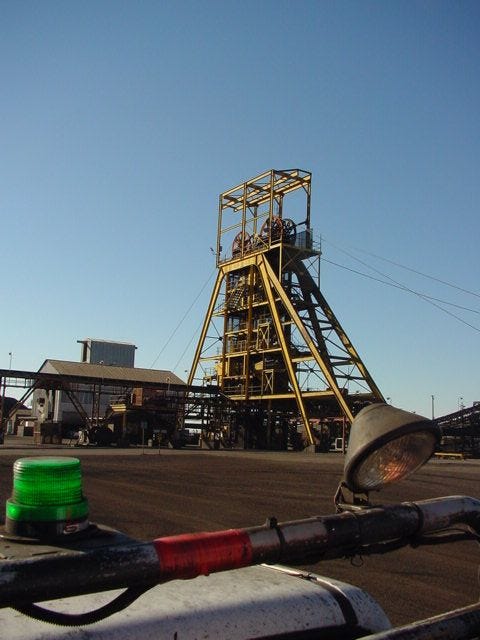
Originally published on LinkedIn. This work is AI-assisted - read about how I work.
The ore body under this low Kalahari hillock, about 75 km from Kuruman, could supply the world’s manganese requirements for 5,000 years. In 2025, the smelter built to process it closed because South African electricity had become too expensive to run a ferromanganese furnace.
The ǀXam San knew this ground long before any geologist mapped it. Their territory ran through the scrublands and river courses of the Kuruman Hills. Wonderwerk Cave, 45 km away, records two million years of continuous human presence in the region. The first geological note on Black Rock appeared in 1908. The first shaft came in 1940.
Assmang was formed in 1935 through a partnership between African Mining and Trust and Anglovaal. In April 1940, they acquired the Black Rock outcrop. Three underground mines now draw from a single ore body: Nchwaning II and Nchwaning III, at depths of 421 and 500 m, and Gloria at 140 m. Nchwaning alone holds 323 Mt at 42.5% manganese. The ore is particularly low in phosphorus: a specification steel mills pay a premium for.
The smelter at Cato Ridge processed Black Rock ore for 66 years and employed 310 permanent workers and 290 contractors. On 31 August 2025, it closed permanently. Electricity costs had risen 930% since 2008. Making ferromanganese in South Africa had stopped making financial sense.
The smelter Assmang built in Sarawak from 2013, operational from 2016, remains open and expanding. It was built there because Malaysian hydroelectric power is reliably cheap. That is why Black Rock ore crosses the Indian Ocean to be processed in Borneo.
Sakura Ferroalloys, the Sarawak plant, is a joint venture with Sumitomo Corporation and China Steel Corporation. It produces approximately 240,000 tonnes of manganese alloys per year. Assmang’s relationship with Sumitomo dates to 1961, when the two companies established a marketing arrangement for Black Rock ore into Japan. In September 2025, Sakura broke ground on a new converter with US$82.5m of committed capital, targeting full production by mid-2027.
South Africa holds the world’s largest manganese reserves and exports almost all of them as ore. The electricity tariff that closed Cato Ridge makes domestic beneficiation uneconomic across the sector. Whether the cost of that has been counted is a different question.
African Rainbow Minerals Limited and Assore Group each hold 50% of Assmang Manganese Black Rock Mine Operations. In 2025, Assmang sold its 54.36% stake in Sakura to Assore for R2.1bn. ARM distributed R900m of those proceeds to shareholders. Assore now owns the Malaysian furnace.
The mines produced 3.7 Mt in 2025. South Africa exported a record 26.2 Mt of manganese in 2025. Assmang is part of a consortium of mining groups, bidding to build a new manganese export terminal at Ngqura, with planned capacity of 16 Mt per year, expandable to 22 Mt.
The constraint was never the ore.