


This version includes additional information about firms not mentioned in the original LinkedIn publication, where you can also read the comments. This work is AI-assisted—read about how I work.
Fairbridges opened in Cape Town on 6 November 1812. John Merrington founded it. At that time, the Cape Colony had no significant mining industry. It had shipping, conveyancing, estates, and the Eastern Cape settler world. That was enough to build the oldest law firm in Africa. And to train some of the men who would build much of what followed.
Thomas Scanlen served at Fairbridges. He became Prime Minister of the Cape Colony in 1881, then departed for Salisbury in 1894 and founded Scanlen and Holderness Legal Practitioners. William Bell served articles at Fairbridges. He moved to Kimberley in 1887 to examine mining claims, then to Johannesburg in 1889, and founded what became Fasken (incorporated in South Africa as Bell Dewar Inc).
The firm trained many of the lawyers who built the bar that followed the ore.
Syfret Godlonton and Low came in 1887, anchored in the same Eastern Cape settler world. The Godlonton name traced to Robert Godlonton, the 1820 Settler, journalist and activist. Three names on one letterhead. Each would carry a thread north on its own account. More on that later.
Both firms worked Kimberley. Fairbridges had copper exposure at Springbok. These were not Cape Town firms that watched the mineral rush from a distance. They colonised it.
Kimberley already had its own bar, though. Duncan and Rothman had opened there in 1881, five years before the rush reached the Witwatersrand. When Bell arrived in 1887, they were already established.
But, the Transvaal was a different matter.
When gold was found on the Witwatersrand in 1886, Kruger’s government enacted a mineral code on a different foundation. Roman-Dutch law vested precious metals in the state. The mynpacht system required licences from the government to mine.
That gap was an advantage to whoever closed it first.
Douglas Gilfillan arrived in Johannesburg in 1893 from the Cape and founded what became Bowmans (Law Firm). Webber Wentzel, Fort Beaufort-founded in 1868, followed. These firms mastered Kruger’s code on the ground. Command of it made them indispensable to the uitlander mining industry and impenetrable to the Cape legal establishment.
A third Johannesburg firm took shape alongside them. Harold Blore opened independently in 1895. Blore and Cliffe by 1902. Cliffe Dekker and Todd by 1926. One of the few firms that could trace its roots to before the Boer War.
Van Hulsteyns had been practising since 1872, before Johannesburg existed. Lewis Peter Ford and Carl Jeppe were partners there. Fordsburg and Jeppestown carry their names today. Johann Rissik’s sons became senior partners; Rissik Street carries his. The legal profession is written into the map of Johannesburg, not just its company registers.
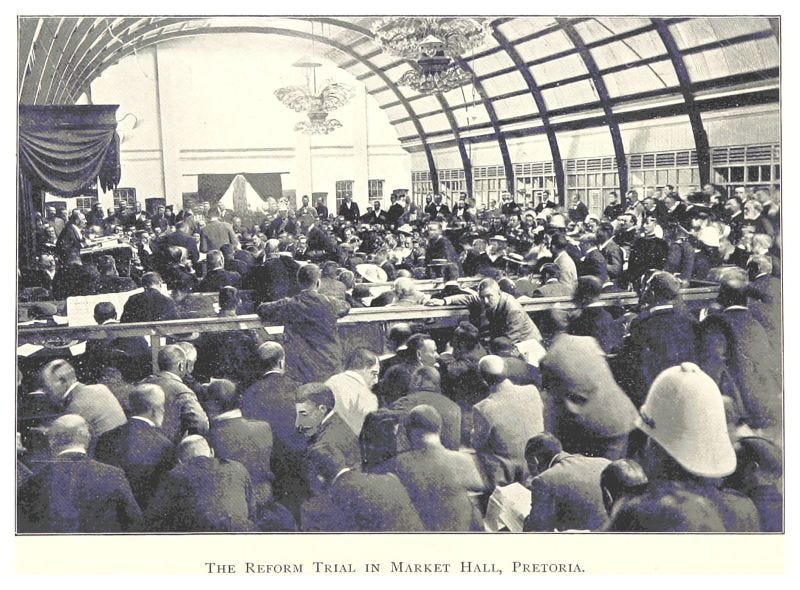
The Jameson Raid of 1895 crystallised what was at stake. Gilfillan participated, was convicted, jailed, and released. Bell was among the accused at the 1896 treason trial in the Pretoria Market Hall. The grievance had a legal core: Kruger’s state-grant system blocked the consolidation of mining claims through private property rights.
The Boer War ended the code.
Deneys Reitz fought in that war, on commando under Smuts. He went on to serve in Smuts’s cabinet and founded a law firm that carried his name for more than a century. It became Norton Rose Fulbright’s South African practice in 2011. In 2026, it returned to independence, and the name returned with it: Deneys.
Union in 1910 created one legal market. Edward Nathan and Friedland had opened in Johannesburg in 1905. Werksmans followed in 1917, the year Nathan Werksman founded it on his twenty-first birthday. A second generation, building on ground the first had already taken.
But the Johannesburg firms had 15 years of embedded mining house relationships and JSE-listed company work.
A note on those three founding names from 1887, because each carried its own thread north.
The Godlonton thread went to Salisbury. A later Godlonton, a son or nephew of Robert Godlonton, the 1820 Settler, became a partner in Gill, Godlonton and Gerrans in 1931. The firm is Band 1 ranked in Zimbabwe today.
The Low thread went to Bulawayo. In 1897, Rhodesia Railways asked a Cape Town lawyer named Webb to open the town’s first legal practice. Webb invited Henry Low to join him. Low was later knighted for his service to the city; a Bulawayo primary school still carries his name. Webb, Low and Barry remains one of the oldest practices in Bulawayo.
The Syfret thread never left Cape Town, and it ran deeper than a law firm. Edward Ridge Syfret took over his late father’s estate and trust practice in 1885. An early client was Cecil Rhodes, and for years the practice looked after the South African side of Rhodes’s affairs: the fruit farms, the cold storage interests, the dynamite subsidiaries, Groote Schuur itself. When Rhodes died in 1902, Syfret’s practice administered the South African portion of the estate. The man on the ground, not a formally appointed trustee.
In 1954, the Syfret trust business reached north into the Federation of Rhodesia and Nyasaland through an association with Gill, Godlonton and Gerrans. Sixty-seven years after Syfret, Godlonton and Low had first shared a Cape Town letterhead, two of those three names touched again.
The law firm itself kept merging in Cape Town. Syfret Godlonton and Low became Syfret Godlonton-Fuller Moore in 1979, after absorbing two more old Cape practices. In 1998 it merged with the Johannesburg firm carrying Harold Blore’s lineage, Cliffe Dekker and Todd, to form Cliffe Dekker Fuller Moore. A further merger in 2008 made it Cliffe Dekker Hofmeyr. Three founding names from 1887, scattered across two countries and more than one industry, folded back into a single firm 121 years later. Every Big 5 law firm absorbed a slice of Cape Town.
Fairbridges remained in Cape Town. Africa’s oldest law firm. Still standing.
The same Eastern Cape settler families simultaneously built many of the banks, the insurers, the asset managers and the great businesses of the region. And gold and Johannesburg was central to that evolution.