


Originally published on LinkedIn on 9 October 2026. This work is AI-assisted - read about how I work.
Gold explains why Johannesburg appeared. It does not explain how quickly everything else followed.
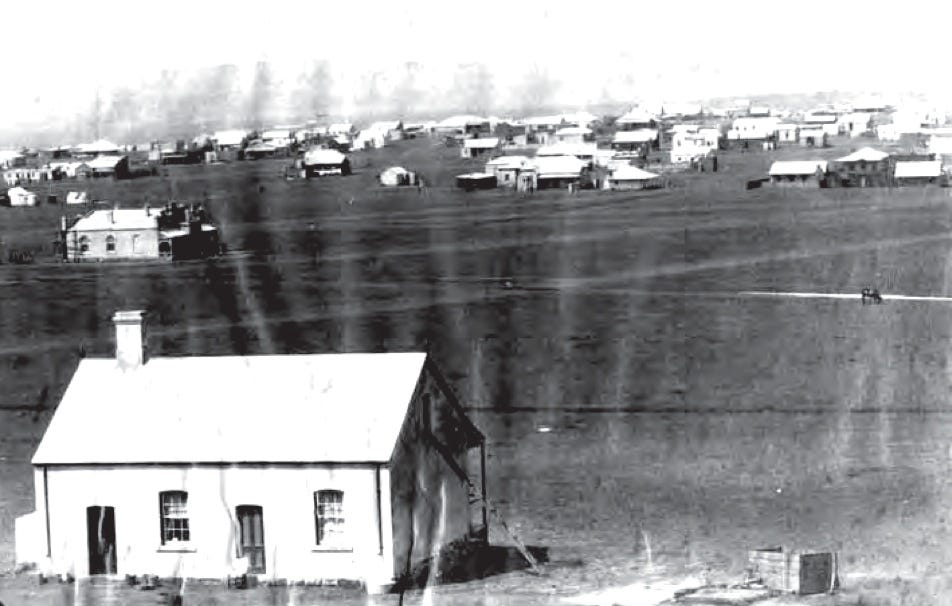
Standard Bank began operating in Johannesburg in October 1886. By February 1887 there was an official market and the Diggers News. A telegraph office followed in April. The Eastern Star, later The Star, moved to Johannesburg in October.
Then, on 8 November 1887, the Johannesburg Stock Exchange was founded. By the end of that month its Official List carried 68 companies.
In little more than a year, a new gold settlement had acquired banking, a market, newspapers, long-distance communications and a securities exchange.
But Johannesburg was being built on different clocks.
It did not become a municipality until 1897. The Rand Water Board was constituted in 1903 and became fully operational in 1905. Waterborne sewerage only began to be introduced in 1906.
Johannesburg could have substantial banks, hotels and commercial buildings while still collecting human waste by night-soil cart.
And the faster institutions were not necessarily the finished ones.
The JSE had been created because share trading needed somewhere to happen. It then had to learn how to be an exchange. By July 1890, more than half the companies that had traded during the preceding year had become insolvent or bankrupt and disappeared from the list. Its rules kept developing.
Water took another route. Private suppliers came first. The sanitary board had limited powers and did not control the water supply. Sources proved inadequate. Eventually the answer became regional: a statutory Rand Water Board bringing together government, municipalities and mining interests.
Nor did the slower clock simply catch up. Johannesburg became an extraordinary economic machine while parts of the city continued to live with developmental failures that eroded basic quality of life. Some things never came right, certainly not for everyone.
That matters when we look at Johannesburg now.
The city does not need to invent a stock exchange, a municipality or a bulk-water institution. But its present difficulties are not simply the story of institutions that once worked perfectly and then declined. In 2026, the City itself acknowledges historical underinvestment in water infrastructure, while audit reporting describes inadequate maintenance and financial pressure.
The remarkable thing about early Johannesburg was not that somebody built a city in fifteen months. They didn’t.
Some things were built remarkably quickly. Some took generations. Some never came right.
And those that did still had to be maintained.
Perhaps that is the harder story of Johannesburg at 140: not how quickly a city can be built, or even how quickly it can deteriorate, but how difficult it is to build one that works for everyone and then keep it working.