


Originally published on LinkedIn. This work is AI-assisted - read about how I work.
The Kalahari does not announce itself. The camel-thorn trees stand in red sand as they have for ten thousand years. Beneath the ground at Kathu Pan, the /Xam San shaped hand axes from rock that was already a million years old. The desert holds its silence. Then Iscor came with a mandate from the South African state, and in 1953 planted the first blast in ground that would become one of the largest open-pit mines on earth.
Iscor had two iron mountains. The other was Thabazimbi — meaning mountain of iron in Setswana. It opened first, in 1931, feeding South Africa’s blast furnaces for 85 years. Multiple life extensions, each a decision to keep investing in a mine running low on ore. A slope failure in June 2015. Transferred to ArcelorMittal for R1 in 2018: not abandonment, a search for one more chapter. Mines close. The resource is finite. What communities are left with is the only question that matters. Thabazimbi’s answer is still being written.
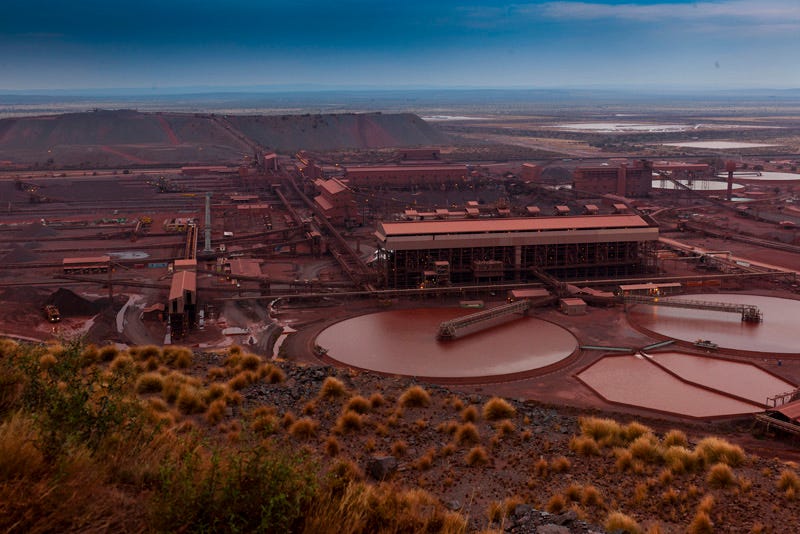
The pit at Sishen is now 14 km long — one of the seven largest open-cast mines on earth. Reserves of 598.6 million tonnes of high-grade hematite; a resource exceeding one billion tonnes. In 2025 it produced 25.3 million tonnes, loaded onto trains running 861 km to Saldanha Bay — the longest production trains on earth, as we told in our earlier story, Distance Decides.
In December 2001 Iscor unbundled its mining assets into Kumba Resources. Anglo American acquired 20.1% for R2.4 billion in March 2002, effective control at 67% by December 2003. November 2006: Kumba split in two. Iron ore became Kumba Iron Ore, listed at R115 per share, market cap R36 billion — one of the largest BEE deals in South African mining history, with Exxaro Resources, community, and employees each taking a stake.
Then the mine was attacked. ArcelorMittal failed to convert its undivided interest in the Sishen mining right before the MPRDA deadline. The Department of Mineral Resources awarded it to Imperial Crown Trading — a politically connected entity whose principals would later be implicated in state capture. Kumba fought to the Constitutional Court. In December 2013 the Court confirmed Kumba’s exclusive right to apply for the residual share. By October 2016 it was back in SIOC’s hands.
The town of Dingleton, 3,400 people, stood 500 metres from the blasting boundary. Kumba spent approximately R3 billion relocating every household to Siyathemba.
The R11.2 billion UHDMS upgrade begins production this year, trebling premium-grade output to 55%. In 2025 Sishen realised US$95 per tonne against a benchmark of US$85. Life-of-mine extended to 2044.
Acquired from Iscor, restructured into one of the largest BEE deals in South African mining history, defended at the Constitutional Court against capture, upgraded for the next two decades: Sishen is one of the great mines of the modern world.
The iron mountain endures