


Originally published on LinkedIn. This expanded version integrates material from my comments on the original post. The argument remains the same; the form is fuller. This work is AI-assisted—read about how I work.
Steenkampskraal has made headlines recently. Less discussed is the Cold War legacy upon which it was built.
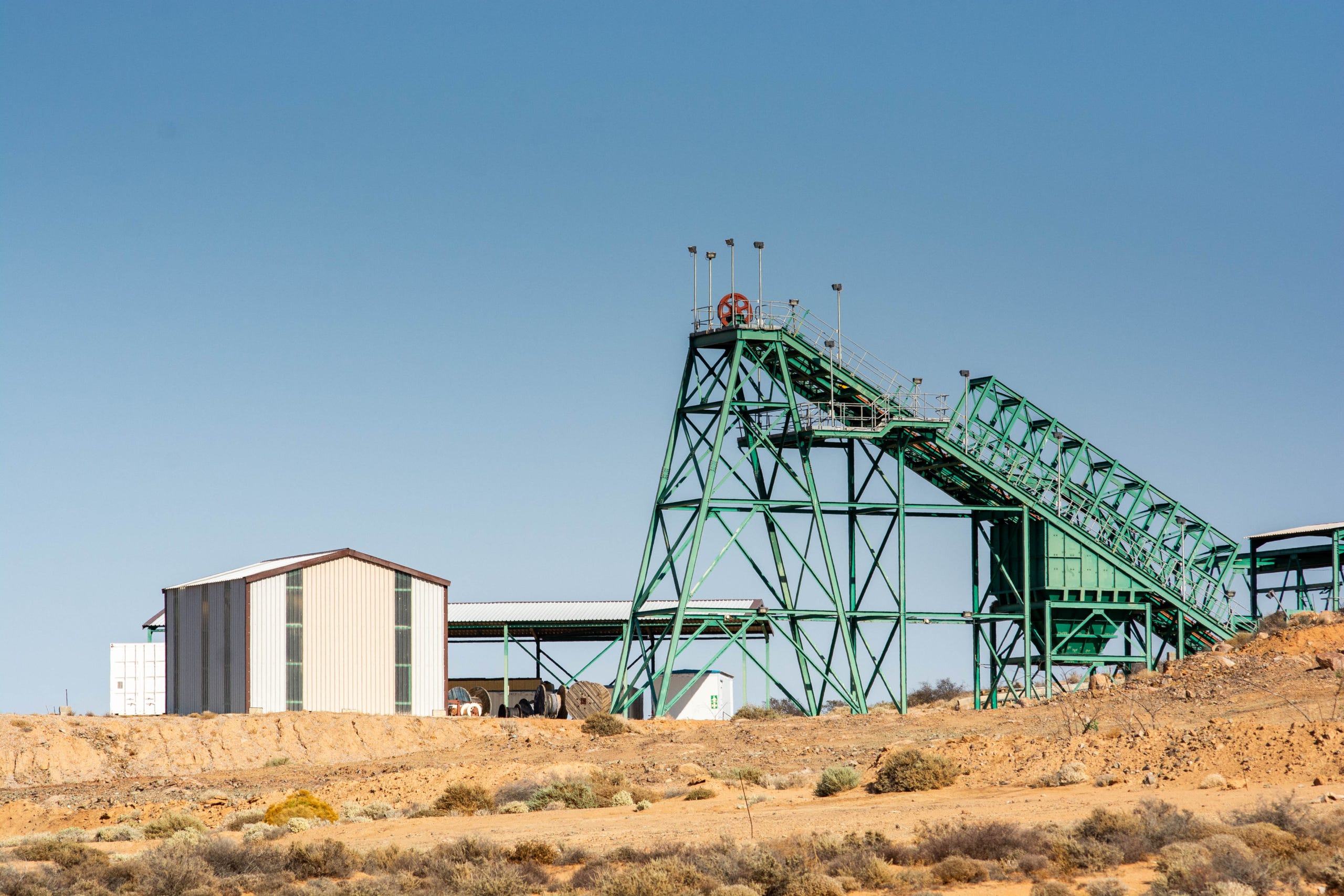
Driving north from Cape Town on the N7, everything empties until there is only light and stone. After Vanrhynsdorp the Knersvlakte opens out. Quartz gravel and low scrub. Kners means to gnash, to grind in Afrikaans. Think wagon wheels on that gravel. Knersvlakte: the plain named itself. Out there, a distinctive koppie waits. Granite with younger rock over older bedrock, tilted and exposed atop the hill. The Khoikhoi knew this rock, dense and dark, heavy to the hand. Geologists today call it monazite.
A geologist described it in 1949. A phosphate mineral containing rare earth elements, and much, much more useful at the time, thorium. With that, this strip of state-owned land was transformed into part of one of the largest intergovernmental nuclear procurement programmes in history, sourcing material from over five continents.
The Combined Development Trust
The system had a name and a founding date. The United States and United Kingdom established the Combined Development Trust in June 1944, before the war it was built to help win had even ended. Its mandate was narrow and absolute: secure control of uranium and thorium, and deny them to the Soviet Union.
The network it built reached across five continents. Belgium, Portugal, Australia, and South Africa were primary suppliers. Brazil signed an agreement in 1945 to supply monazite, the same mineral found at Steenkampskraal, but banned exports by the early 1950s once Brasília understood what it was giving away. Czechoslovakia was the one that got away, its deposits falling behind the Iron Curtain after 1948, worked by political prisoners in the Jáchymov mines.
South Africa’s contribution included monazite explicitly named in the CDA framework. When Brazil closed its exports, that contribution became more critical still. By late 1945, General Leslie Groves could report that CDT-controlled countries held roughly 97% of the world’s uranium ore and 65% of its thorium ore.
This was not a military operation. It was a procurement system. It left almost no public trace. And one of its supply points was Steenkampskraal.
America and Britain formed the Combined Development Agency during the war. Pricing and decision-making power was hashed out between governments, mining companies tasked with extraction. Concentrate was sold to Thorium Ltd in England, and separately to customers in the United States and Germany. Information about what left the country was covered by statutory secrecy provisions in South Africa and beyond. Left behind were tailings.
In total, over 11 years of operation, 126,269 tonnes were processed, of which 59,447 tonnes was concentrate. It was sent overseas.
In 1963 the British government pulled out of buying thorium. Uranium reactor technology had achieved commercial dominance. The plant and the mine were closed down. The state signed a Notarial Lease years later, accepting responsibility for rehabilitation.
What secrecy hid
Few knew what was underneath while the veil of secrecy persisted: at 14.5% total REE oxides, Steenkampskraal is the highest-grade REE deposit in the world. The ore they mined thorium from is one of the highest-value REE deposits ever discovered. They were mining the wrong element.
And now even thorium has another use. As it decays it produces radium-228, useful in targeted alpha therapy, a treatment for cancer using radiation that attacks tumour cells one cell at a time. Thor Medical ASA has begun construction of the AlphaOne plant in Norway. The Industrial Development Corporation released the first funding tranche for Steenkampskraal’s metallurgical plant.
The Khoikhoi took what they wanted from the koppie and left the rest. As did the Cold War Western powers. Both were oblivious to what else lay inside. This is ground that surprised.
In 1952, the South African state appointed an Anglo American subsidiary to mine Steenkampskraal, under the authority of the Minister of Mines.
Malan the negotiator
Researching this story meant finding a country I know reasonably well suddenly unfamiliar. A life lived in South Africa teaches you the mining names by heart: Springbok, Kimberley, Welkom, Witbank, Rustenburg, Johannesburg. Steenkampskraal was not among them, which was strange, since it sits in a part of the country I know well.
The breakthrough was realising Steenkampskraal belonged to a Cold War nuclear procurement system. Once that was clear, the thread was there to pull. It led to an article I had not expected, one that puts Winston Churchill and D.F. Malan in the same sentence. Lucky Asuelime, writing in New Contree in 2014, argues that Malan used South Africa’s atomic materials as political leverage, not merely as a Commonwealth obligation being met. He was not a passive supplier. He was a negotiator.
The article does not mention Steenkampskraal directly. But it establishes the posture from which reasonable inferences can be drawn about a government that understood exactly what it was sitting on, and treated it as a bargaining chip rather than a duty. The history is murky, and there may be more to this story than what is available online. This is the nature of secrets: the silences are part of the record too.
Why this matters now
Steenkampskraal is in the news because of rare earth elements. But the critical minerals framework is newer than the mine.
The Combined Development Agency was, in structural terms, a critical materials system. It secured allied supply and denied adversarial access. The language of the 1940s was thorium, uranium. The logic is recognisable today.
The geometry is not. The Cold War had two blocs and a clear denial architecture. The current contest is between the United States and China, with new alignments forming around each, and a larger pool of nations navigating what that means for them.
The question that matters for this series: what does this mean for the people of South Africa, who are the owners of these mineral resources. That is the question the CDA era never had to ask.