


Originally published on LinkedIn. This work is AI-assisted - read about how I work.
A flooded shaft sat above a copper resource whose true size the operators who abandoned it never knew. That is the story. Everything else is how it happened.
The Lamba people smelted and traded copper in this part of the Copperbelt long before any shaft was sunk or any company registered. When Roan Antelope opened in 1928, it was built on ground that already had a copper history.
The community grew around it over the following decades — houses, schools, a hospital, a football club, a way of life built on the assumption that the copper would always be there. The mine shaped the town, and the town existed because of the mine. In the good years, wealth flowed outward into the Copperbelt and far beyond it. In lean years, anxiety did the same.
The disruption came not from the geology but from the economics of transition. In the late 1990s, Zambia privatised its copper mines — the ZCCM sell-off that broke the state’s grip on the Copperbelt and handed individual assets to private operators under terms that, in several cases, proved unworkable. Luanshya went to the Ramcoz Group. Then, in 2000, Ramcoz collapsed. The company could not survive the commodity trough. Shops closed. The population contracted. Luanshya became known as the ghost town of the Copperbelt — a phrase that carried weight because the other copper towns knew they were not far behind.
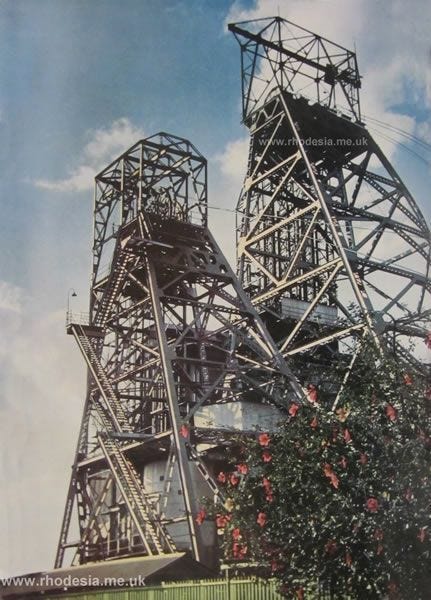
A Chinese state company, CNMC, acquired the operation in 2009. But Shaft 28 — the expansion that should have been the mine’s future — had flooded during the collapse and was abandoned. The shaft sat under 170 million cubic metres of water for twenty-three years while the community above it contracted, waited, and adapted to a horizon that kept not arriving.
At the time of closure, something important was not fully understood: the resource beneath Shaft 28 was substantially larger than the operators had mapped. CNMC’s later reassessment put the increase at close to three times what was previously known.
Copper was worth roughly $1,800 per tonne when Ramcoz walked away. It trades at around $13,000 today. The energy transition runs on copper — more of it per unit of electricity generated and distributed than any comparable material. Zambia has set a national target of three million tonnes per year by 2031. Shaft 28 is named in that strategy — not a vague aspiration, but a named shaft in a specific town, producing toward a number the government has publicly committed to.
CNMC invested $710 million in the recovery. $200 million went to infrastructure upgrades in 2024 and 2025. In December 2025, dewatering finished. 170 million cubic metres were pumped out. Underground rehabilitation is now underway. The first ore hoisting is planned for August 2026. When at full production: 3,000 jobs.
The shaft didn’t fail. The system did. The shaft waited.