


Originally published on LinkedIn. This work is AI-assisted - read about how I work.
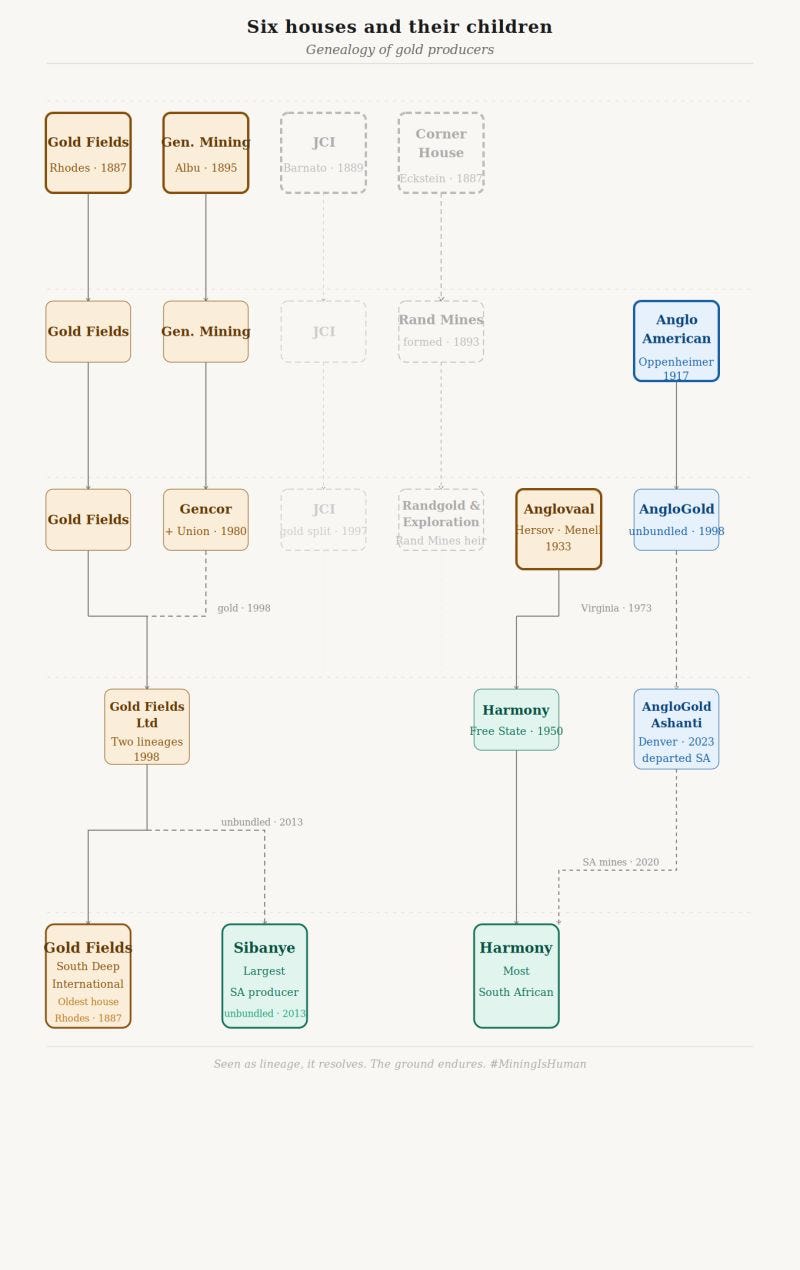
While the Corner House ran the Rand’s first gold operations from the corner of Commissioner and Simmonds Streets, the genealogy of gold formed around it. Barnato’s JCI and Rhodes’ GOLD FIELDS staked rival claims on the Witwatersrand.
Anglo American emerged as the Oppenheimers’ answer to both. Anglovaal would be the first house capitalised entirely in South Africa. Gencor the last, born from Afrikaner and German threads merging in 1980. Six houses seeded today’s gold producers.
The Witwatersrand gold industry carries more history than most can hold: shafts, strikes, silicosis, unbundlings, fraud. What remains resolves as lineage, not map.
Gold Fields of South Africa is the oldest surviving house — Rhodes and Rudd, 1887. It absorbed Gencor’s gold assets in 1998, consolidating two lineages into one listed entity. In 2013 it unbundled KDC and Beatrix as Sibanye, retaining South Deep alongside international assets in Australia, West Africa, and the Americas.
Sibanye-Stillwater is Gold Fields’ South African heir — the mines Gold Fields no longer wanted, now the largest gold producer operating on South African soil. Since 2020 it holds majority control of DRDGOLD Limited — the JSE’s oldest listed share, founded 1895 as Durban Roodepoort Deep, now retreating the Witwatersrand’s residue one tailings dam at a time. Sibanye carries a Gold Fields, a Gencor and a Rand Mines legacy.
Harmony Gold Mining Company Limited is the consolidator. Rand Mines founded it in 1950. Anglovaal merged its Virginia and Merriespruit mines into it in 1973. It grew by absorbing what others discarded — ARMgold, Avgold and Target, and the remaining AngloGold Ashanti mines, including Mponeng, in 2020. Built as much by acquisition as inheritance, it remains the most South African of the survivors.
Anglo American was founded in 1917 as a coalition — Oppenheimer, Newmont Company, JP Morgan — built around gold. It unbundled AngloGold in 1998 and progressively sold down its stake through the following decade, exiting the commodity that made it.
AngloGold merged with Ashanti Goldfields in 2004. By 2020 it had shed its South African assets. In 2023 it moved its headquarters to Denver. Its South African gold chapter closed. AngloGold remains an African operator — Mali, Ghana, Guinea, DRC — just no longer from here.
JCI — Barnato’s vehicle, 1889 — produced no living gold vessel on South African soil. Fraud consumed both JCI and Randgold and Exploration, the Rand Mines heir at Corner House. The platinum thread survived as Valterra. The gold did not.
The neighbours: Pan African Resources PLC in Barberton, Village Main Reef on the Rand. And to the north, Lonrho, RioZim and Falcon Gold — once houses in their own right, now absorbed or dormant.
On the Witwatersrand, six houses started. Three survive on South African soil. One departed to Denver. One dissolved into fraud. One works the residue.
The ground endures.