


Originally published on LinkedIn. This work is AI-assisted - read about how I work.
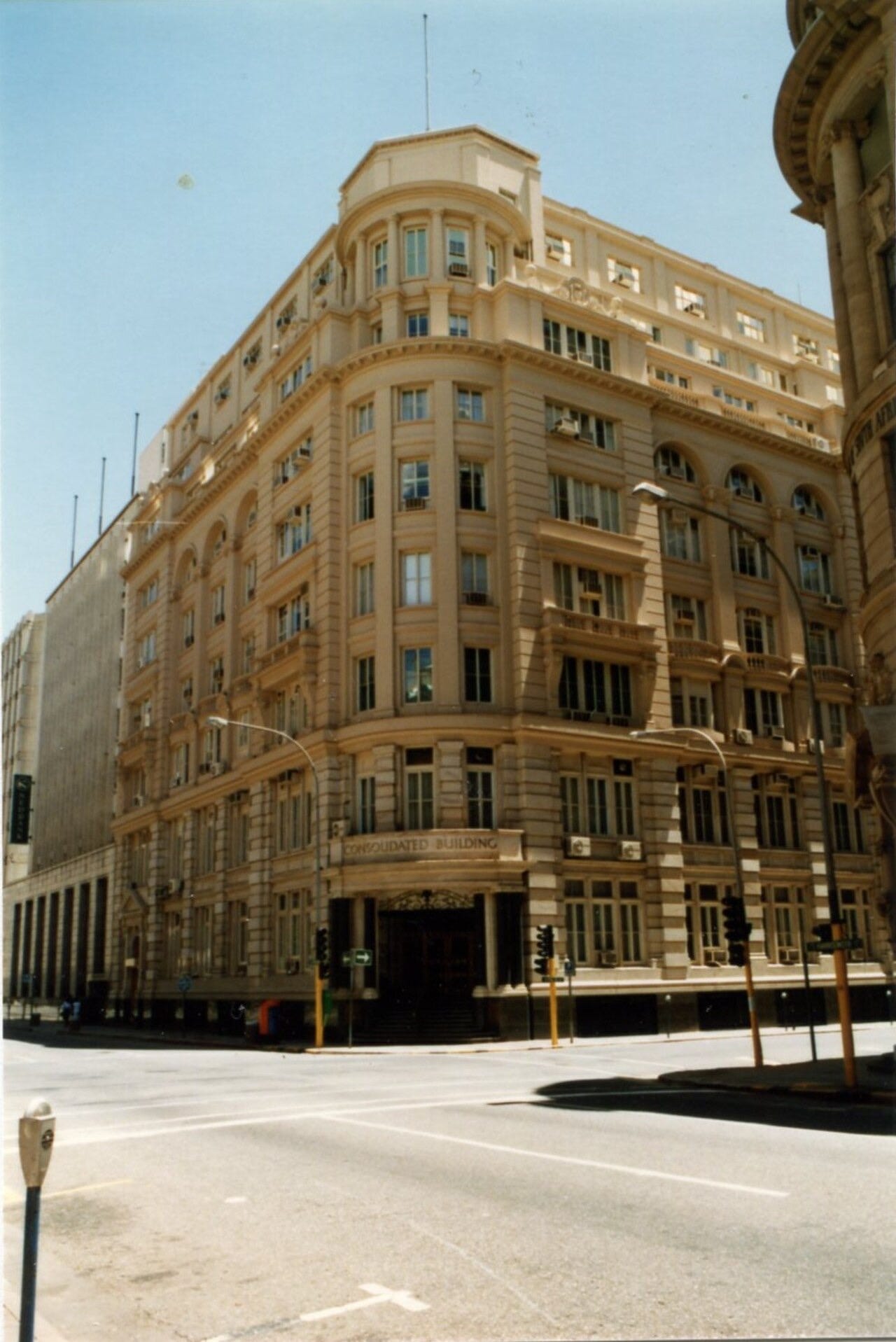
There are two buildings in central Johannesburg that command historical weight. JCI House on Harrison Street. Corner House, a few blocks away, where Rand Mines once sat. Both facades remain. Both companies are gone.
Barney Barnato founded JCI in 1889 using the De Beers stake he received at Kimberley. The house arrived with diamond capital, already large. Barnato did not live to see what it became. On 14 June 1897, he went overboard from the Scot near Madeira. He was 46. His death was recorded as suicide. Control passed to three nephews.
What the nephews inherited was not only gold. By the 1930s, Randfontein Estates ran 600 stamp mills and was the largest gold producer in South Africa. JCI also held steel, engineering, financial services — an industrial conglomerate few mining houses attempted. After 1994, it became one of the first major BEE vehicles in the South African economy, industrial in scale.
Corner House was built by Julius Wernher and Alfred Beit — Barnato’s great rival from the Kimberley diamond fields, now his Rand contemporary. Their vehicle, Rand Mines, was incorporated in 1893. In 1971 it was absorbed into Barlow Rand. In 1992 its gold interests were spun out as Randgold and Exploration. It was from here, in 1995, that a man named Mark Bristow left to build in Francophone West Africa what the legacy might have become. Barrick acquired his Randgold Resources in January 2019 for US$18.3 billion. Bristow’s path diverged long before the turmoil that overtook both houses.
Instead, what followed for both houses was Brett Kebble. In the early 2000s, Kebble controlled JCI and Randgold and Exploration simultaneously, using scrip-lending of listed shares as collateral. The scale of the theft was never definitively established. The number that entered the record was R26 billion. Court proceedings in 2006 confirmed R500 million missing from JCI alone. The company filed no audited accounts for years. Its most valuable mine, South Deep, survived only by passing to Gold Fields.
On 27 September 2005, Kebble was shot in his car in Johannesburg. The NPA later characterised the death as an assisted suicide. By then, he had been removed from both entities. Both houses were hollow before he died.
Randgold and Exploration’s one surviving thread runs through DRDGOLD Limited, the tailings retreatment company founded in 1895, which survives on the JSE — reclaiming gold from dumps, not rock. JCI’s platinum assets passed into Anglo American’s structure and emerged in 2025 as Valterra Platinum.
What these houses left behind was not a mine, not a listing, not a surviving descendant company in the ground. A man who left before the collapse and built what the house had stopped being. A PGM company, newly independent and carrying forward assets JCI once held into another century. A story of what once was, and two grand facades.
I worked for JCI from early 1987 up to just about the end, in early 2001. Not in that lofty corner house palace, but intially out in James Park, Randfontein (where the Geology Department based based) and for the last 6 years, in Accra, Ghana.
During that time the identity of my employer changed from Johannesburg Consolidated Investment Company Ltd, to JCI Ltd, and eventually To Western Areas Ltd. There was a stint of JCI Gold in there too. Even though we competed with Anglo American in exploration (during my time in Ghana), we always felt the eyes of big brother (and significant shareholder) Anglo looking over our shoulder. In hindsight, when Mzi Khumalo and Brett Kebble got involved, the writing was on the wall. On the ground we trying to grow organically, by searching for gold deposits in West Africa, while the top level of the company was doing very strange deals that almost nobody else understood. We were told that this was because they were more clever than us, which might also be true.
Anyway, we had a good team in Geology and the various supporting services, and we were let down by all that funny business at the top. I was managing exploration (and later merely holding the fort while someone found a company to buy out our licences) as all that change accelerated.
Sad.