


Originally published on LinkedIn. This work is AI-assisted - read about how I work.
Ernest Oppenheimer made the largest private capital bet in South African history. It rested on a fixed price. In July 1944, 44 nations signed the Bretton Woods Agreement and pegged gold at US$35 per troy ounce. For a generation, nobody had to guess what gold would be worth.
The land had been Basotho. Free State-Basotho Wars, 1858 to 1868. Treaty of Thaba Bosiu, 1866. British annexation, 12 March 1868. The dispossession created the dependency. The mines would follow 80 years later.
The gold beneath it was invisible. No surface expression. Thick sediment cover. No reef to follow down. Oppenheimer was financing something nobody could see. Anglo American was thirty years old. It had survived the Depression and a world war. Oppenheimer was not consolidating what Anglo had built. He was betting on what it could become.
Eight mines in production by 1955: St Helena, Welkom, Western Holdings, Free State Geduld, President Brand, President Steyn, Erfdeel-Dankbaarheid, Loraine. Eight mines in eight years. Built from featureless grassland at depths between 1,200 and 1,500 metres, with no industrial-scale road, rail or water infrastructure on the surface.
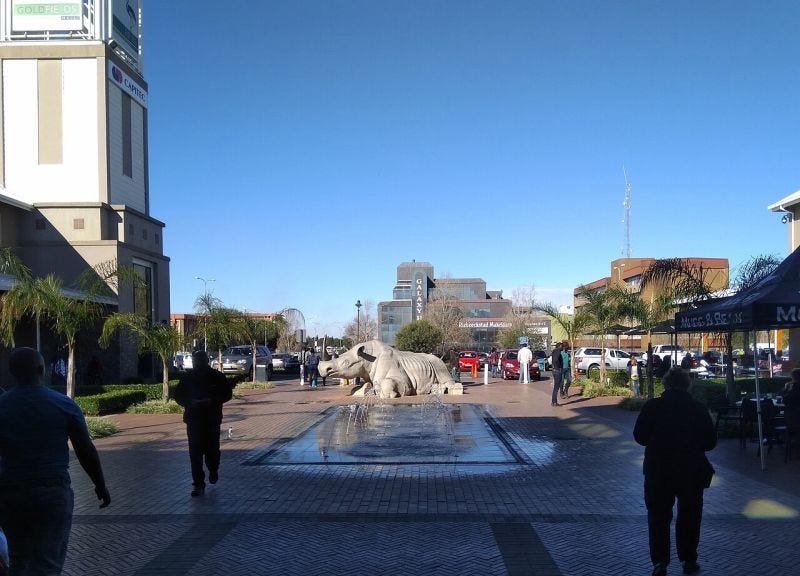
Oppenheimer turned the first sod on 16 May 1947. Anglo built Welkom for these mines. Workers came from Lesotho, Mozambique, Malawi, the Eastern Cape. Matjhabeng, the Sesotho name the municipality carries today, describes a place different nations were forced to assemble.
Anglo maintained for decades that it had sought family housing for Black workers in Welkom, and that apartheid policy blocked it. It made that case again at the Truth and Reconciliation Commission.
In more than a century of Anglo American's history, few decisions match this one in scale. Not the founding in 1917. Not the De Beers consolidation. Not the reach that eventually put two-thirds of the JSE under one family's influence. Nor anything since.
The bet worked. At peak, close to a fifth of free-world gold came from these eight mines. 180,000 workers. Applying the Minerals Council's current one to nine multiplier: an estimated 1.7 million livelihoods.
In August 1971, Nixon suspended Bretton Woods. The fixed price was gone. By 1989, gold had fallen from its 1980 peak of US$850 toward US$400. What had been built for a guaranteed price now faced a falling one.
The institutional heir to that bet was AngloGold Ashanti, formed from Anglo's 1998 gold consolidation and the 2004 Ashanti merger. In 2020 it sold its remaining South African assets and left. Harmony Gold Mining Company Limited and Sibanye-Stillwater remain, working shafts on declared end-of-life timelines. By the mid-2020s, around 30,000 workers where there were once 180,000.
Mining extracts a non-renewable resource. When the economics shift, operators sell. The gold runs out. The jobs and prosperity built around it go with it. The only question is what was left behind.
Welkom is still deciding how to answer that.