


Originally published on LinkedIn. This work is AI-assisted - read about how I work.
The JSE was founded in 1887. DRDGOLD Limited listed in 1895.
Every other company from that era, every Randlord structure, every house, every syndicating vehicle from the first rush, has been absorbed, renamed, dissolved, or relocated offshore. Rand Mines, the oldest mining house on the Rand and the house DRDGOLD descended from, restructured its gold interests into Randgold & Exploration in 1992. Brett Kebble looted it. JCI, through which DRDGOLD shares were misappropriated to fund the looting, did not survive it. DRDGOLD did, barely, and is the only one that did.
Anglo American built plants on the same dumps and sold them; Harmony Gold built itself from what the houses were selling.
DRDGOLD is still there, producing gold - from the surface.
DRD was a West Rand deep-level operation. Underground gold production began in 1898. The last shaft ran until 2001, on borrowed time against prices that made depth uneconomic. By 2012 it had left underground mining altogether.
Anglo commissioned Ergo in 1977 to recover gold from East Rand dumps. It produced 8.19 million ounces before closing mid-decade. DRDGOLD revived it from 2008, took full control by 2015, and built the world’s leading surface tailings operation around it.
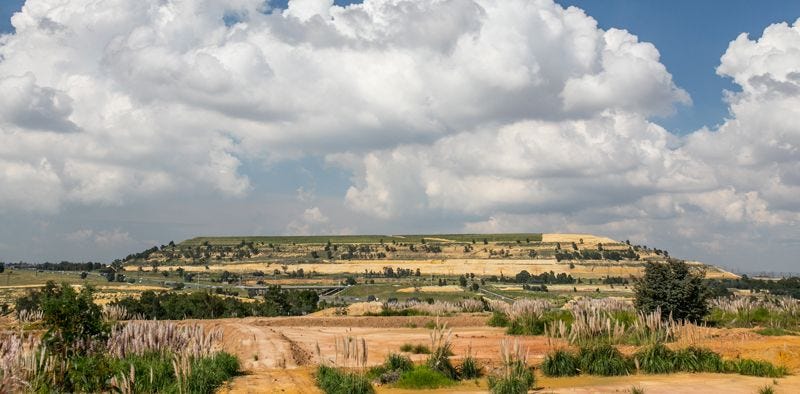
Witwatersrand milling over 140 years deposited six billion tonnes of residue across 400 to 500 square kilometres of Gauteng. The original mills recovered 40 to 60% of the gold. Modern carbon-in-leach recovers up to 90% of the same material. The dumps are not waste. They are a deferred resource.
In 2018, Sibanye-Stillwater transferred West Rand surface tailings to DRDGOLD for a 38% stake. Reserves increased 82% without a single drill hole underground. Sibanye took its option to 50.1% majority in January 2020; by then the investment had risen 147%.
Today DRDGOLD operates Ergo near Brakpan and Far West Gold Recoveries near Carletonville, combined capacity 1.8 million tonnes per month. FY2025: 155,288 ounces at 0.189 g/t, 44.7% operating margin, 18th consecutive dividend, 903 permanent employees. The Brakpan plant runs on a 60 MW solar array providing about half its power.
A 2024 Stellenbosch University study estimated up to 420 tonnes of gold remain locked in the tailings, in pyrite that carbon-in-leach cannot reach. DRDGOLD’s research partnership with Wits is working to reach it. If Wits cracks the chemistry, the company will have reinvented itself again. That is the only thing it has ever done.
Underground became surface and waste became reserve, against odds that closed every mine around it. Each worked-out section is rehabilitated, savannah grass returning to ground that held slimes for decades. Every company that listed beside it in 1895 is gone.
The last alongside it was a brewery, founded the same year to slake the same rush, now sold and delisted. DRDGOLD is still here, in Johannesburg, making money from what the rush left behind.