


Since this story was published, the National Energy Regulator of South Africa (NERSA) approved a concessionary electricity tariff of 62c/kWh for the Glencore-Merafe Chrome Venture’s ferrochrome smelters. The story was first published on LinkedIn on 21 May 2026, where you can read the original post and comments. This work is AI-assisted—read about how I work.
Three weeks ago this series stood in Burgersfort and looked down at the Steelpoort Valley from the PGM side: chrome trucks on every road, a corridor capital arrived to transform and only partly did. The chrome seams are the other side of that story. The Koni, predecessors absorbed into the Bapedi state, were iron-workers here from at least the 1600s. Tjate, royal capital of Sekhukhune I, thirty kilometres from the smelter site, carries iron-smelting remains from around AD 700 and is a Provincial Heritage Site. The forge was not merely industrial. Specialist smiths. Defined taboos. Transformation of ore to metal treated as an act of creation.
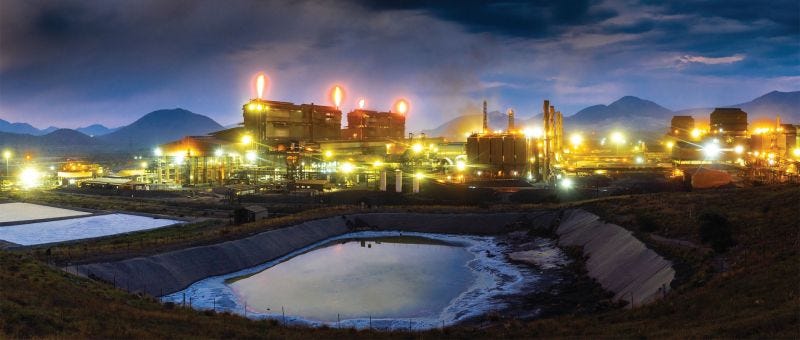
Thousands of years on, the valley still transforms ore to metal. The Glencore-Merafe Chrome Venture runs five ferrochrome smelters and seven chrome mines across the Eastern and Western Limbs of the Bushveld Complex. Installed capacity: 2.3 million tonnes per year, the single largest ferrochrome production complex on earth. Twenty-two furnaces. The Lion Smelter at Steelpoort uses Premus kiln technology, drawing 37% less electricity than conventional processes. When the tap hole opens, molten ferrochrome runs into the ladle at 2,800 degrees, sparks.
The venture formed on 1 July 2004. Glencore, then Xstrata, had built its chrome position through acquisition: Chromecorp in 1994, CMI in 1998 for $215 million. Neither party sold assets to the other. They pooled operations into a notarial pooling and sharing venture, splitting EBITDA: Glencore 79.5%, Merafe (JSE:MRF) 20.5%. The Competition Tribunal validated the structure. Roughly 30% of global output. Glencore absorbed Xstrata in 2013; the structure carried over.
South Africa holds 72% of the world’s chrome reserves. China holds none. China now produces more ferrochrome than South Africa. Not because the ore ran out. Not because demand fell. Since 2008, South Africa’s industrial electricity tariff increased by more than 900%. Tariff required for viability: 62 cents per kilowatt-hour. What the venture was paying in late 2025: approximately R1.36. Output fell to 586,000 tonnes: 25% of capacity, down 63%. Section 189 notices to 1,200 to 1,400 workers. Wonderkop and Boshoek to care and maintenance. Burgersfort’s boom came partway and stalled. The chrome valley’s constraint was different: not geology, not capital. Electricity.
Lion Smelter tapped its first ferrochrome on 16 February 2026, on an interim tariff. The 62-cent permanent rate awaits NERSA approval, expected by 15 June. The S189 process has been extended three times. Workers at the idled smelters remain on full pay, status unresolved.
The valley’s relationship with metal is not new. What is new is that whether the furnaces run is decided in Pretoria, on a price negotiated with a state utility. The forge was sacred here. Now it is precarious.