


Originally published on LinkedIn. This work is AI-assisted - read about how I work.
Today, another departure. Last week, I took a detour from hashtag#MiningIsHuman to talk a little about law firms and mining. This week, the banks of Johannesburg. This research is light, so reader insights are most welcome.
The gold arc does not end at the shaft collar. It ends at the vault.
Standard Bank opened its first Johannesburg branch on 11 October 1886. Not in a building. In a tent. Ferreira’s Camp. Canvas walls, £10 rent, and a ledger for a gold field that had been producing for less than three months.
The bank had done this before. It started in Port Elizabeth in 1862. It went to Kimberley when diamonds were found. It went to Johannesburg when gold was found. By the mid-1890s, the Transvaal was generating 40 percent of Standard Bank’s global profits.
The building that followed the tent tells you what those profits meant.
By 1908, the corner of Harrison and Commissioner Streets carried a six-storey neo-Baroque structure with a 15,000-square-foot banking hall, an oak counter 152 feet long, and a basement fitted out for assaying. Gold extracted underground came to the surface, crossed the street, and went underground again. Tested, weighed, valued. Dedicated bullion elevators. Adjacent strong rooms. The bank was not financing the gold economy. The bank was part of it.
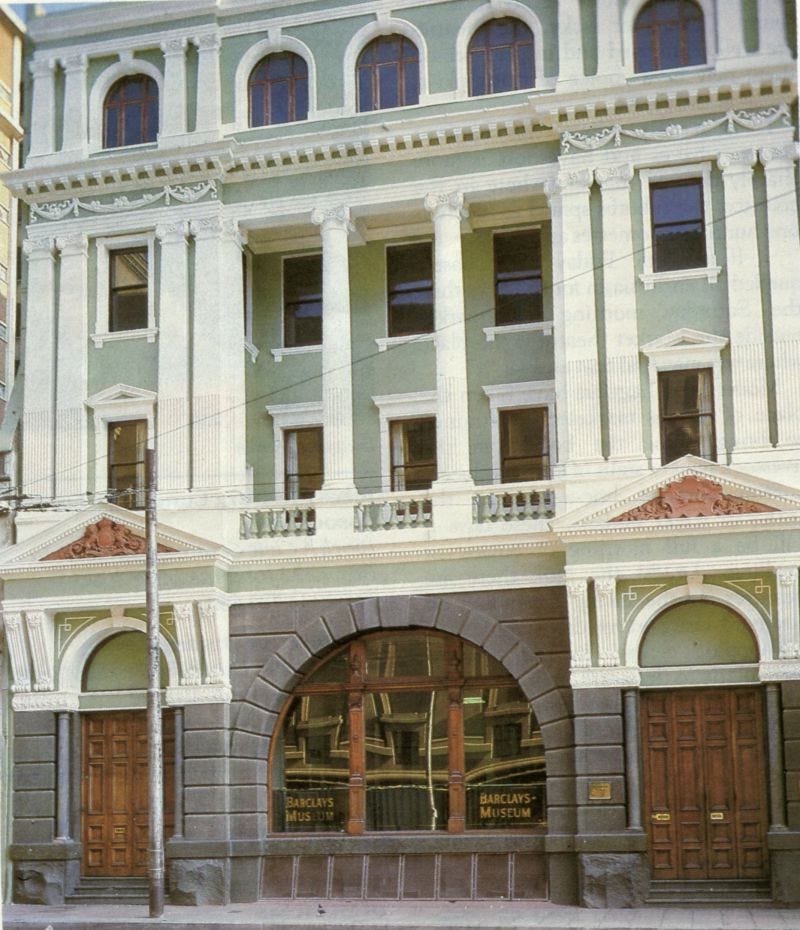
The Natal Bank arrived in 1891. Its 1903 building on what is now Albertina Sisulu Road is Johannesburg’s oldest surviving bank building. Declared a Provincial Heritage Site. Privately acquired in 2011, it fell into disrepair, then was restored as a technology hub.
The National Bank of the ZAR arrived in 1891. Kruger created it because gold had made banking a political question. Its building at Simmonds and Commissioner Streets is a declared national monument.
A Dutch institution, the Nederlandsche Bank en Credietvereeniging, arrived in 1888 to give the Republic a non-British option. It avoided the mines entirely. It became Nedbank.
The lineages compress a century. Standard Bank tent to Standard Bank Group. The Natal Bank passed through the National Bank of South Africa, then into Barclays. Barclays sold its South African shareholding in 1986 under disinvestment pressure. A South African consortium acquired the operations. In 1987 it re-emerged as First National Bank. Barclays later returned through Absa, then exited again. The Natal Bank’s building outlasted them all. Its lineage now sits inside FirstRand as FNB South Africa. The Dutch bank became Nedbank.
When Standard Bank built its current head office at 5 Simmonds Street, excavation uncovered a stope from Ferreira’s Mine. The mine that drew the first miners in 1886. They preserved it. The mine was underneath the bank the whole time.